FIP treatment with subcutaneous remdesivir followed by GS-441524 oral tablets

Richard Malik DVSc PhD FACVS FASM Center for Veterinary Education, University of Sydney
Original article: Treatment of FIP in cats with subcutaneous remdesivir followed by oral GS-441524 tablets

Translator's note: The article contains information about the actual content of GS-441524 in tablets. However, this content may not correspond to the "equivalent" amount of GS-441524 in tablets from other manufacturers, where the actual content of GS-441524 is always slightly higher due to the known reduced bioavailability of the orally used drug. Therefore, it is not possible to simply and unambiguously compare the recommended dosage of GS-441524 from BOVA in Australia and here.

Introduction

Infectious feline peritonitis (FIP) is an infectious disease, especially of young cats. It occurs when a feline enteric coronavirus that multiplies in the gut undergoes a critical mutation that changes its tissue tropism from enterocytes to macrophages. The FIP virus then circulates in the body in macrophages - this is the ultimate mechanism of the Trojan horse. This leads to disseminated infection and the development of fibrinoid necrotizing vasculitis and serositis due to the deposition of immune complexes consisting of feline antibodies and FIP viral antigens.

In general, there are two forms of FIP - effusive ("wet") FIP and non-effusive ("dry") FIP. The disease process itself can occur in the abdomen, thoracic cavity, pericardium, eyes or central nervous system. Combinations of dry and wet FIP with various tissues are not uncommon.

Until recently, the diagnosis of feline infectious peritonitis (FIP) was a death judgment for a feline patient. In recent years, however, this vision has been turned upside down as a result of the pioneering work of Professor Niels C. Pedersen and colleagues at UC Davis.

Over the last 12 months, many veterinarians in Australia have also successfully managed many cases of FIP using remdesivir and GS-441524.

Omega-interferon (Virbagen) and polyprenyl immunostimulant (PPI) were the first drugs used to treat FIP, and both had some effects in some patients. Omega interferon has been useful in cases of effusive ("wet") FIP, often combined with low-dose prednisolone according to the Ishid protocol, while PPI, pioneered by Al Legendre, has been more useful in cases of non-fusible FIP. In some cases, both drugs were used at the same time. The problem was that both forms of therapy were often expensive, especially when both drugs were used, so that although patients improved and could have transient clinical remissions during treatment, permanent clinical cures were rare. As a result, most veterinarians still considered the diagnosis of FIP a prelude to euthanasia.

That all changed a few years ago thanks to the culmination of FIP's lifelong research. Niels Pedersen. Niels is an amazing North American veterinarian of Danish descent. He grew up on a chicken farm and originally wanted to be a clinician for large animals, but with great foresight he decided on a scientific career. Shortly after graduating, he traveled to Canberry to the John Curtin School of Medical Research at ANU, where in the late 1960s he received a PhD in kidney transplant rejection immunology from Professor Bede Morris, using sheep as an experimental model to study lymphocyte kinetics.

When Niels returned to UC Davis, he focused on studying infections and immunity. Although he has contributed to a large number of topics in internal medicine and the genomics of dogs and cats, FIP has become his favorite disease due to its commonness and current complexity. His studies date from the 1980s, when he specialized in diagnostics, virology and pathogenesis, to the present, with an increasing focus on therapy.

Niels, in collaboration with colleagues from Kansas State University, has shown that a purposefully designed protease inhibitor GC-376 could prevent and cure experimentally induced FIP in laboratory cats.1,2 Field clinical trials with cats with naturally occurring disease have been disappointing, especially when cats have had an ocular form of FIP or CNS disease. He did not give up, so he switched to another drug - GS-4415243,4 - a nucleoside analogue developed by the North American pharmaceutical company Gilead. This molecule has been shown to be much more effective than GC-376 in the treatment of FIP, both in experimental infections and in spontaneous cases of FIP. Starting with pharmacokinetics and dose escalation studies using a wide range of clinical cases, Niels and colleagues found that the required dose depended on whether the patient had dry or wet FIP and whether the eye or central nervous system (CNS) was affected.5

Surprisingly, Gilead, the manufacturer who developed GS441524, has not yet shown interest in developing this molecule for the treatment of cats. To fill the gap for effective FIP therapy around the world, various laboratories in China and Eastern Europe have begun producing GS-441524 and selling it on the black market.

The wide availability of the GS-441524, often of high quality and initially very high price, provided dedicated owners with a way to save their cats with FIP. Studies by clinical pathologist Samantha Evans of Ohio State University have indicated a cure rate of approximately 80 % in the field. Until recently, the procurement of the drug was complicated and full of problems, which at some level were circumvented by various "FIP Warriors" groups on Facebook. Unfortunately for Australian cat lovers, APVMA and Vet Boards finally understood what was going on and the Border Force made it much more difficult to obtain GS-441524 and its safe import for veterinary use. Regulatory and Veterinary Committees' warnings against prosecutors were directed against veterinarians who allowed cats with FIP to be treated with black market drugs.

Ironically, the COVID 19 pandemic provided a new solution to this problem. Gilead developed remdesivir (GS-5734) as a drug for the treatment of hepatitis C, Ebola and human coronavirus disease. Remdesivir is a prodrug of GS-441524, which contains an additional chemical side chain (including a phosphate group) to improve intracellular penetration (Figure 1B). Remdesivir (as a product of Veklura) obtained a temporary marketing authorization (for two years) from TGA in July 2020 for the treatment of SARS-CoV-2 infections in human patients with COVID-19. This registration process would normally take several years, but the severity of the pandemic has accelerated this process, taking into account preliminary data from clinical trials. As remdesivir became a licensed human drug and Gilead licensed production worldwide, it meant more access to quality raw material. This circumvented the problems with the use of the drug purchased on the black market, as well as the problems of unknown purity and consistency of the product over time.

In 2020, the veterinary compounding company BOVA Australia provided reliable supplies of remdesivir in a suitable format for IV and subcutaneous application. Studies in Australia have determined that the shelf life after reconstitution exceeds 12 days and have confirmed in vitro efficacy against coronaviruses in tissue cultures. The analytical purity of the drug is regularly checked by HPLC. Over the past year, veterinarians in every Australian state have used remdesivir to treat cats with FIP. There have been a number of effusive and non-fusive cases, including some cats with ocular disorders (uveitis) and others with multifocal CNS disease. Based on treatment of approximately 500 cats treated between October 2020 and November 2021, remdesivir has been shown to be highly effective in managing FIP infections. It allows for a slightly simpler subcutaneous administration and the injection appears to be slightly less painful compared to GS-441524 and does not cause the local injection site reactions observed with GS-441524 injection. Remdesivir was originally used exclusively in Australia, although it has also been available in the UK from BOVA UK for the last 2 months.

The molecular weight of remdesivir is 603 g / mol, while the molecular weight of GS-441524 is 291 g / mol. This could suggest that treatment of cats with remdesivir requires approximately twice the dose of GS-441524, although this does not take into account the possible improvement in intracellular penetration of remdesivir into certain tissues compared to GS-441524. The proposed dose of remdesivir in human patients with COVID19 is 200 mg intravenously (IV), followed by 100 mg IV daily. For a 70 kg human patient, this represents a daily dose of 1.3 mg / kg, so using allometric scaling, a dose of 5-10 mg / kg per day was considered correct for a cat. However, our experience with the first 500 cases was that many cats eventually needed a higher dose of remdesivir for permanent cure, so we adjusted our recommended dosage upwards (see below). Remdesivir provides BOVA as a sterile 10 mg / ml solution ready for use in a 10 ml vial.

Figure 1. (A) BOVA Remdesivir reconstituted and ready for treatment. After reconstitution, the contents of the vial are stable for at least 120 days at 5 ° C - and the vial is usually consumed in 3-7 days. It is best to store the vial in the refrigerator. (B) The pathway that remdesivir travels intracellularly to activate as GS-441524.

At present, Australia and the United Kingdom are the only countries where remdesivir is readily available by prescription for veterinary use. However, veterinarians in India, New Zealand, South Africa and parts of Europe have also started using human medicine suppliers to access the medicine.

Diagnosis

Figure 2: Amazingly comprehensive and practical overview of FIP diagnostics by Severine Tasker.

A complete differential diagnosis of FIP is beyond the scope of this article, but readers are strongly encouraged to read the excellent article by Séverine Tasker in the Journal of Feline Medicine & Surgery. 6

Although FIP can occur in cats of any age, most cases occur in kittens and cats less than 3 years of age. Persistent and often high fever that does not respond to antibiotic therapy (and often NSAIDs) is a common finding, as is increased plasma total protein levels due to elevated globulin concentrations (diffuse gammopathy in serum electrophoresis). In effusive or "wet" FIP, the albumin to globulin ratio may drop to <0.45. Acute phase reactants such as serum amyloid A and α1-acid glycoprotein tend to be markedly elevated. Many cats with FIP also exhibit secondary immune-mediated hemolytic anemia, increased AST and ALT activities, and jaundice.

Diagnostic imaging is crucial for early diagnosis, which has been greatly facilitated by the introduction of digital radiology and the widespread availability of diagnostic ultrasound in small animal practice. Pleural effusion is readily recognizable from chest X-rays, while abdominal effusion is best detected by ultrasound (Figure 3), especially if high frequency probes are available. It is worth noting that in some cases, the fluid pockets may be focal and localized. Often there is some fluid around the kidney under the kidney sheath, kittens may have scrotal edema, while in rare cases the discharge is limited to the pericardial sac. But the key is - to look for (i) effusion in any body cavity, (ii) granulomas in the kidneys, liver or lungs, (iii) enlarged intra-abdominal and mesenteric lymph nodes (Figure 5) or marked thickening of the iliac-ecological area (f focal FIP ’) ( Figure 5). Chest X-rays after drainage of pleural effusion may show changes corresponding to viral pneumonia.

Figure 2: (A) Ultrasound of the abdomen showing abundant highly echogenic fluid (fibrin fibers) in cats with high protein ascites due to effusive FIP. (B) The fusion contains a viscous yellow to straw-colored liquid. (C) An X-ray of the abdomen with the appearance of cut glass indicating fluid in the abdomen.

If you see an effusion - puncture - because fluid is the best diagnostic sample.

Figure 3: Marked mesenteric lymphadenomegaly in a cat with dry FIP.

A fluid with a high protein content, often yellow to straw in color, is characteristic (Figure 3B). If you see granuloma in the organ or if the lymph nodes are clearly enlarged - do FNA (thin needle aspiration biopsy), apply a smear, use RapidDiff staining and look for neutrophils and macrophages (pyogranulomatous inflammation) without visible infectious agents (Figure 4). The two diseases most commonly confused with FIP in adult cats are lymphoma and some types of lymphocytic cholangitis (associated with high protein ascites).

Figure 4: RapidDiff stained aspirate with a thin needle from the mesenteric lymph nodes of a 4-year-old oriental cat with dry FIP. Distinctive macrophages are the key to cytological diagnosis. Photo courtesy of Trish Martin.

Of course, effusive disease is much easier to diagnose because ascitic, pericardial or pleural fluid provides a suitable sample that can be examined cytologically, by fluid analysis and immunofluorescence (IFA) for FIP antigen, or reverse transcriptase PCR to detect FIP nucleic acid. IFA is performed at VPDS, B14, University of Sydney (via Vetnostics, QML, ASAP, VetPath, Gribbles or IDEXX). However, it is usually the cheapest way to send the sample directly to the university laboratory.

Dry FIP is more problematic because it usually requires a thin-needle aspiration biopsy of pyogranulomatous lesions in the liver, kidneys, or abdominal lymph nodes. Occasionally, cases of wet FIP may show fluid samples that are negative for IFA and / or PCR testing, but the patient is still likely to have FIP, which is reflected in a favorable response to remdesivir or GS-441524 treatment.

Treatment

Since October 2020, we have been treating cats with FIP with remdesivir (IV and SCI) and more recently with GS-441524 (oral), so our protocols are constantly evolving with experience. About 500 cats have been treated so far. We try to avoid being too prescriptive in our recommendations, as we suspect that there is no one-size-fits-all protocol and that each case presents unique circumstances, including patient size, whether the cat is still "happy" and reasonably , or is depressed and dehydrated. An important factor is the emotional and financial commitment of the owner. A key feature that needs to be mentioned is that both drugs are very safe, even in sick cats and kittens.

Note that the following recommended doses are higher than those originally recommended a year ago. Although lower doses worked in many patients, we found that this was often the wrong economic consideration, as disease recurrence at the end of treatment and the development of viral resistance during treatment appear to be related to insufficient initial dosing. So we have learned to be more aggressive from the beginning, which is cheaper in the long run (ie 2nd therapy is not required)

Our greatest experience is with remdesivir. This drug is expensive and the owner has to commit to a costly treatment process that takes 3 months. For most clients, this represents an emotional and financial burden. My view is that in many cases it is better to spend money on antiviral therapy as such than on extensive diagnostics and monitoring.

Figure 5: Significant thickening of the ilico-ecological area of the Devon Rex cat with the so-called "focal FIP", a common form of non-fusive FIP. Photo courtesy of Penny Tisdall.

One of the approaches in newly diagnosed cats with severe disease is hospitalization of cats during the first 3-4 days of treatment. Patients begin treatment with remdesivir when receiving IV fluid therapy (typically 2-4 ml / kg / hr; first day Hartmann's solution or Plasmalyte followed by 0.45 % NaCl and 2.5 % dextrose containing 20 mmol KCl / l). On the 1st day of hospitalization, remdesivir is administered in a high dose intravenously (10-15 mg / kg diluted in 10 ml with saline and is given SLOWLY for 20-30 minutes or longer, manually or by infusion pump; in human patients, administration lasts 2 hours. ) to achieve an increased starting dose of drug distribution volume. This achieves fast antiviral efficacy. In cases with CNS disease, we recommend a daily IV dose of 20 mg / kg. Many cats may appear slightly depressed several hours after IV remdesivir infusion. In human patients, remdesivir may cause infusion-related reactions, including low blood pressure, nausea, vomiting, sweating or chills, but we have not observed these events in our feline patients.

The advantage of starting treatment intravenously is that dehydration, if present, is corrected and you have IV access if you need to take other medicines (eg anticonvulsants, corticosteroids). Importantly, once an IV catheter is inserted, daily injections of remdesivir do not cause any pain or discomfort. However, if the cat eats and is diagnosed in the early stages of the disease, then IV therapy is not required and the same doses can be given subcutaneously, saving a lot of money.

FIP cats treated with remdesivir typically improve significantly during the first 2-3 days. However, we found that cases of effusion, and especially those that resulted in pleural effusion prior to treatment, should be closely monitored, as the combination of the antiviral effect of remdesivir and a higher than maintenance dose of crystalloids may lead to transient worsening of pleural effusion. This requires drainage twice a day using a 19G butterfly needle (1.1 mm - cream color) and a 3-way stopcock (ideally using an ultrasonic guide to find the best place to insert the needle). These "secondary" pleural effusions can be fatal if not detected in time and appear to occur in approximately 1 in 10 cases of effusive FIPs treated with remdesivir.

Another problem that occasionally occurs at this time is the development of neurological symptoms, including seizures. Our view is that this is not the effect of the drug as such, but rather the unmasking of the subclinical CNS FIP. Such cats require careful monitoring, while the development of seizures requires the use of anticonvulsant drugs such as midazolam (0.3 mg / kg IV), alfaxane or propofol (administered IV to be effective), followed by levetiracetam (Keppra) (10- 20 mg / kg, PO every 8 hours). Phenobarbitone is a reliable anticonvulsant, but it tends to increase the metabolism of many drugs, and levetiracetam is probably safer until we better understand the pharmacokinetics and metabolism of remdesivir and GS-441524. Some doctors also administer dexamethasone or prednisolone as a single treatment to relieve CNS inflammation.

Although advocating initial IV therapy for the most severe cases of FIP, cats and kittens that are still "happy" and eating do not require IV therapy at first and may instead begin subcutaneous injections at 10-12 mg / kg / day (20 mg / kg in CNS diseases). This is, of course, much cheaper because cats or kittens do not have to be placed in an infusion pump and hospitalized in a stressful environment. For clients who have financial limits, this may be a more appropriate way to start therapy. Some skilled colleagues, such as Jim Euclid, have developed a hybrid approach where kittens receive subcutaneous fluids daily as a bolus with injected remdesivir.

The cats were then given continuous subcutaneous injections of remdesivir. It originally took 84 days, and such cases accounted for most of the cases we have dealt with so far. Recently, we have been using aggressive IV / SCI remdesivir for initial therapy, and then cats are switching to oral GS-441524 for 10 weeks of consolidation therapy.

After the initial use of lower doses, which were not successful in every patient, we now use the following treatment protocols:

  • for cats with wet FIP: 10-12 mg / kg once daily (SID) for 2 weeks
  • for cats with severe eye impairment: 15 mg / kg SID by subcutaneous injection (SCI) for 2 weeks; Cats with severe uveitis should also be given topical corticosteroids (Before Forte or Maxidex) for 2-3 days (no longer!) and atropine eye ointment.
  • for cats with neurological FIP with CNS symptoms: administer 20 mg / kg SID SCI for 2-4 weeks. 5

It is important that owners are properly instructed on how to optimally administer daily injections. Cats will perceive the injection as less painful if the remdesivir solution in the syringe is allowed to warm to room temperature instead of being refrigerated. In addition, if you teach them simple tasks such as using a new needle when injecting (ie use a needle other than the one used to draw the medicine from the vial) and using 21G (0.8mm - green) or 23G diameter needles (0.6mm - blue), injections will be more tolerable. Although 21G needles are larger, some cats may have the advantage of injecting faster. Alternatively, for simplicity, veterinarians can prepare injections for the whole week, which they will keep in the refrigerator, and will give a new injection every day.

For cats that continue to perceive SC injections as painful, we used gabapentin orally (50 to 100 mg per cat) and / or transmucosally or SC administered buprenorphine 30-60 minutes before sedation / analgesia injection. The area to be injected can also be trimmed so that a topical EMLA cream can be applied 30 minutes before the injection. BOVA produces a faster-acting local anesthetic gel that may be useful in some patients. In exceptional cases, we inserted a cephalic catheter every 4-5 days so that owners could administer IV therapy instead of SC injections. Injection site reactions reported with GS-441524 injected abroad do not appear to occur with remdesivir.

After 2-4 weeks of taking remdesivir and after the abdominal fluid has disappeared and the ocular and CNS symptoms have improved or disappeared, we are now proposing a switch to GS-441524 tablets. This is done for 3 reasons: (i) it reduces costs (ii) eliminates the pain problem of SC injections (iii) in some patients it is more effective. Remdesivir injections are probably more reliable than oral GS-441524, and in the worst cases, you might choose to give them for 4 weeks, but for most cats, 2 weeks and comfort and lower oral formulation costs outperform everything else.

The use of GS-441524 tablets is relatively new in Australia but is widely used overseas. The recommended oral dose of GS441524 is generally the same as the SCI/IV dose of remdesivir: wet FIP cases receive 10-12 mg/kg PO SID, ocular cases 15 mg/kg PO SID and CNS cases 20 mg/kg (or higher). GS-441524 is more economical and is even safer than remdesivir. In CNS cases where large doses are given, it is probably best to give 10 mg/kg PO every 12 hours (BID) to circumvent the “ceiling” effect that has been reported in relation to limited absorption of high doses.

Figure 6. Focal dry FIP with pyogranulomatous inflammation of intra-abdominal lymph nodes. Instead of exploratory laparotomy, lymph node biopsy, histology, and immunohistology, 3 days of remdesivir IV treatment may be more cost-effective if FIP is highly suspected. Enlarged lymph node FNA is probably an ideal diagnostic option for physicians with this set of skills.

Why are the dosages about the same? At mg / kg, GS441524 has twice as many active molecules as remdesivir (due to the difference in their molecular weight), but the bioavailability of GS-441524 is only 50 % (only half of what is given is absorbed, and this is affected by feeding and also the effect of the ceiling dose) - so these two factors cancel each other out.

We recommend that GS-441524 tablets be given with a small treat to mask the tablet, with the main meal being served 1 hour later. The tablets provided by BOVA are 50 mg tuna-flavored tablets, with four score lines, so they can be divided into halves or even quarters.

In situations where owners cannot afford full treatment, we use mefloquine (Lariam; 5 mg / kg orally once daily in capsules or 62.5 mg twice a week) after initial treatment with remdesivir / GS-441524.

Phillip McDonagh, Jacqui Norris, Merran Govendir and colleagues at the Sydney School of Veterinary Science have shown that mefloquine has an antiviral effect. 7 This is probably due to the fact that mefloquine usurps the biochemical intracellular pathways used by the FIP virus, a mechanism that has recently been demonstrated with clofazimine. 8 (anti-leprosy medicine), and several other medicines. In several cats, where owners could not afford a complete treatment with remdesivir, mefloquine proved to be effective in reaching the limit of clinical cure.

The main advantage of buying remdesivir and GS-441524 from BOVA for the treatment of FIP cases is that the products we use are subject to quality control. It's just a prescription with the client's name and address, the patient's name and the dose to be given, and the compounder can usually deliver the vials or tablets to any veterinarian in Australia within 24-48 hours.

At present, the price is 100 mg of vials of remdesivir 250$ plus GST and postage (the total price is usually about 280$). GS-441524 is sold in packs of 10 tablets for 600$ plus shipping and handling. By purchasing more vials and tablets at the same time, of course, postage and handling fees will be reduced. We believe that most owners will feel much more comfortable getting a product from a well-known Australian company than sending money overseas and hoping that drugs of unknown quality on the black market will reach Australia safely without being detained by customs.

There is no reason why a well-motivated veterinarian would not be able to handle these cases in his own practice. This is often more convenient for the owner, especially if they struggle with daily injections and need a practice near them.

Figure 7: Gs-441524 tablets from BOVA Australia. They are tuna flavored. They can be divided into halves or even quarters. MUCH EASIER than injections for most cats. Less stress and less cost.

Veterinarians who wish to explore this option or have general questions about FIP case management may email Sally Coggins (dr.sallyc@gmail.com), Richard Malik (richard.malik@sydney.edu.au), David Hughes (concordvets@concordvets.com.au), Grette Howard (drgretta@gmail.com) or Professor Jacqui Norris (jacqui.norris@sydney.edu.au), for advice on diagnosis or treatment. Many Australian veterinarians interested in FIP have gained considerable expertise in the management of these cases. For example, Andrew Spanner in Adelaide treated more than 20 cases with excellent results. Thus, there are already many feline medicine physicians and internal medicine specialists with experience in the treatment of FIP, and so veterinarians who are hesitant to treat their own cases have the opportunity to recommend these specialists to their clients.

Physicians who accept FIP cases from GPs include: QLD Rhett Marshall, Marcus Gunew, Alison Jukes, Rachel Korman; NSW Katherine Briscoe, Michael Linton, Randolph Baral, Melissa Catt; VIC - Carolyn O'Brien, Keshuan Chow, Amy Lingard; WA-Martine Van Boeijen and Murdoch University Veterinary Hospital; TAS Moira van Dorsselaer.

All of these doctors (and probably even more we don't know about) are happy to accept cases for diagnosis and therapy. Everyone is probably happy to discuss case management with you.

Figure 8: Bengal kitten with CNS and ocular FIP (A: before) and (B: after) after Remdesivira. This cat also had pulmonary granulomas.

Sally Coggins, working with Lara Boland, Emily Pritchard, Associate Professor Mary Thompson and Professor Jacqui Norris at the Sydney School of Veterinary Science, is interested in treating cases with comprehensive diagnosis and free monitoring. It will be part of Sally's doctoral program, so you will help her advance in her studies by sending her cases. We hope that through these studies, we will get a better idea of how quickly cats respond and when exactly treatment can be safely stopped. Owners will only have to pay for remdesivir and GS-441524 for therapy. This group is also interested in treating cases with interferon-omega and mefloquine.

In most cases, FIP is doing very well with GS-441524 or remdesivir. Niels Pedersen has gathered an amazing resource for veterinarians interested in FIP case management - https://sockfip.org/dr - pedersen - research / . The site also provides some recommendations on how to monitor cats during treatment. I'm not very protocol-oriented, so the key things for me to keep track of are appetite, attitude, activity levels, and changes in body weight and fitness over time. Most physicians like to monitor serum hematology and biochemistry every month to ensure that all measurable abnormalities improve, although this can be stressful for the patient and increase treatment costs. The trade-off is taking a few drops of blood to monitor PCV, total plasma protein (TPP) using refractometry, and plasma color to determine if anemia is improving, jaundice is subsiding, and gamma globulin levels are lowering, resulting in lower TPP.

Do not worry about transient increases in globulin levels at the start of treatment; when high protein effusions are absorbed, a lot of immunoglobulins enter the patient's plasma. This phenomenon may be common until the 8th week of treatment, but disappears by the 12th week.
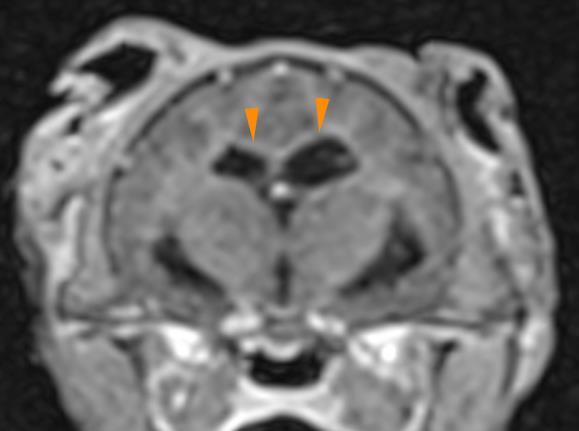
Figure 9: Transverse plane MRI image in contrast to T1 weighting. Note: dilatation of the lateral ventricles with very slight emphasis on the ependymal lining (orange arrows). Image courtesy of Christine Thomas.

And what about a kitten with multifocal CNS disease, where FIP CNS is the most likely cause of clinical symptoms? The traditional approach is serology (to rule out cryptococcosis and toxoplasmosis), a good history and thiamine test to rule out vitamin B1 deficiency, followed by MRI scans (Figure 9) and CSF collection for fluid analysis and multiplex neuro-qPCR analysis). This approach is very expensive and there is also a certain risk of anesthesia and especially CSF collection. We found that a 3-5 day intravenous or sc. Remdesivir therapy can be used as a therapeutic test in cats with probable CNS FIP and is a cost-effective alternative to complete diagnostic processing, which can cost 3-5000$ or more.

Similarly, if exploratory laparotomy, abnormal tissue biopsy, histology, and immunohistochemistry for FIP antigen are used to diagnose dry intra-abdominal FIP versus 3-5 days of treatment with remdesivir or GS-441524, a drug test may be considered, which is a better choice from in terms of patient well-being and reduced costs. Most cats with non-fusive FIP experience rapid improvement with antiviral therapy, with normalized fever, improved appetite, and better overall attitude within 2 to 3 days. If the patient does not respond to antiviral therapy, then exploratory laparotomy and representative organ biopsy are reasonable, as the main differential diagnoses are lymphoma and lymphocytic cholangitis.

This is a matter of personal approach for each doctor. FNA for cytological and sometimes immunohistochemical examination or PCR is a convincing non-invasive option where this expertise is available, but sometimes it does not give a definitive answer. Some veterinarians insist on tissue diagnosis and positive immunohistology or PCR in each patient, while others would like to "treat treatable" with a 3-5-day remdesivir / GS-441524 application and proceed to exploratory laparotomy only when there is no clear response to therapy.

It is incredibly satisfying to see the transformation of cats and kittens, which are not well, into normal and happy cats. It's really something that will lift your spirits as a doctor. It's good science and good veterinary medicine!

Conclusions

In the past, the diagnosis of FIP was an intellectual exercise so that we could end the suffering of a cat or kitten with the certainty of an accurate diagnosis. Now, thanks to FIP's lifelong study, Dr. Niels Pedersen, we are able to successfully treat perhaps 80 % or more cats with FIP if the client has sufficient funds. It is too early to predict whether or how many will be repeated later.

There is a need for intensive study in diagnosis and case management, but with the necessary effort, a good veterinarian should be able to work with a determined owner to achieve a clinical cure. The most important thing is not to put too many obstacles in the way of the dedicated owner and support him during the 12-week marathon treatment course by helping him find the best way to treat his patient. This may include sedative / analgesic treatment to help the cat improve controllability and prevent discomfort when the client brings their cat to the clinic daily for remdesivir injections or switching to GS-441524 tablets when the stress from the injections is too great for the owner. It is important to go a long way and a payment plan can be provided that will allow determined clients to improve the affordability of treatment.

Finally, the impact of COVID-19 on coronavirus research has been indeed profound, and several very promising drugs are under development, such as molnupiravir from Merck and another oral drug from Pfizer.

OVERALL SUMMARY

2-step approach to therapy

Phase 1 - INDUCTION

IV / SC injections of Remdesivir

  • For cats with wet FIP: 10-12 mg / kg remdesivir by subcutaneous injection (SCI) once daily (SID) for 2 weeks
  • For cats with eye: 15 mg / kg SID remdesivir SCI for 2 weeks
  • For cats with neurological symptoms of FIP and CNS: remdesivir 20 mg / kg SID for 2 weeks

Phase 2 - CONSOLIDATION

Switch to GS-441524 tablets after 2 weeks of remdesivir injection

  • For cats with wet FIP: 10-12 mg / kg GS-441524 oral SID for 10 weeks
  • For cats with eye impairment: 15 mg / kg SID GS-441524 oral SID for 10 weeks
  • For cats with neurological symptoms of FIP and CNS: GS-441524 10 mg / kg oral BID (20 mg / kg / day) for 10 weeks

References

  1. Kim, Y .; Liu, H .; Galasiti Kankanamalage, AC; Weerasekara, S .; Hua, DH; Groutas, WC; Chang, KO; Pedersen, NC Reversal of the progression of fatal coronavirus infection in cats by a broad-spectrum coronavirus protease inhibitor. PLoS Pathog. 2016, 12, e1005531.
  2. Pedersen, NC; Kim, Y .; Liu, H .; Galasiti Kankanamalage, AC; Eckstrand, C .; Groutas, WC; Bannasch, M .; Meadows, JM; Chang, KO Efficacy of a 3C-like protease inhibitor in treating various forms of acquired feline infectious peritonitis. J. Feline Med. Surg. 2018, 20, 378–392.
  3. Murphy, BG; Perron, M .; Murakami, E .; Bauer, K .; Park, Y .; Eckstrand, C .; Liepnieks, M .; Pedersen, NC The nucleoside analog GS-441524 strongly inhibits feline infectious peritonitis (FIP) virus in tissue culture and experimental cat infection studies. Vet. Microbiol. 2018, 219, 226–233.
  4. Pedersen, NC; Perron, M .; Bannasch, M .; Montgomery, E .; Murakami,
    E .; Liepnieks, M .; Liu, H. Efficacy, and safety of the nucleoside analog GS441524 for treatment of cats with naturally occurring feline infectious peritonitis. J. Feline Med. Surg. 2019, 21, 271–281.
  5. Dickinson PJ, Bannasch M, Thomasy SM, et al. Antiviral treatment using the adenosine nucleoside analogue GS-441524 in cats with clinically diagnosed neurological feline infectious peritonitis. Journal of Veterinary Internal Medicine. 2020. doi: 10.1111 / jvim.15780.
  6. Tasker S. Diagnosis of feline infectious peritonitis: Update on evidence supporting available tests. Journal of Feline Medicine and Surgery.
    2018; 20 (3): 228-243. doi: 10.1177 / 1098612X18758592
  7. McDonagh, P .; Sheehy, PA; Norris, JM Identification, and characterization of small molecule inhibitors of feline coronavirus replication. Vet. Microbiol. 2014, 174, 438–447.
  8. Yuan, S., Yin, X., Meng, X. et al. Clofazimine broadly inhibits coronaviruses including SARS-CoV-2. Nature (2021).
    https://doi.org/10.1038/s41586-021-03431-4
  9. https://sockfip.org/ - THE BEST resource on the internet or anywhere for FIP.
Figure 10: Two cats with dry FIP after successful therapy. As an avid young veterinarian wrote to me not so long ago - "that's why I did science!"

COSTS:

2 kg kitten with wet FIP
4 × 100 mg remdesivir vials - 1000$
35 × 50 mg tablets GS-441524 - 2100$
Manipulation and GST - 30$ plus 310$ = 340$
A total of 3440$, approximately 290$ per week for 12 weeks

4 kg cat with dry FIP
7 × 100 mg remdesivir vials - 1750$
70 × 50 mg tablets GS-441524 - 4200$
Handling and GST 30$ plus 600$
A total of 6550$, about 545$ per week for 12 weeks

Figure 11: Two siblings who developed FIP and were successfully treated with remdesivir and GS441524.

Serum protein electrophoresis

Kristiina Ruotsalo, DVM, DVSc, ACVP & Margo S. Tant, BSc, DVM, DVSc
Original article: Serum Protein Electrophoresis - General

What are serum proteins?

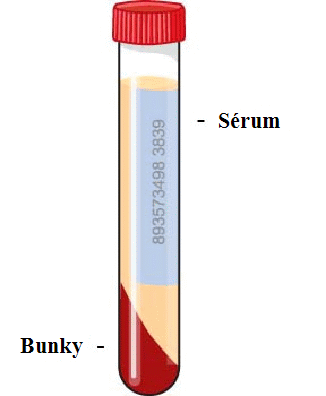
Serum is the liquid part of the blood from which red blood cells, white blood cells and blood clotting factors have been removed. The serum contains a large amount of protein, which performs various functions. These functions include providing cell nutrition, protecting against infections, acting in inflammation, and acting as hormones or enzymes.

What is serum protein electrophoresis?

Protein electrophoresis is a specialized test that analyzes specific groups of proteins in the blood serum and measures the proportion of each group of proteins. Individual proteins have characteristic sizes and electric charges. Electrophoresis divides serum proteins into broad groups based on their size and electrical charge. The results of the analysis are shown in a special graph and a pattern of different proteins is used to diagnose specific diseases, including some types of cancer.

What proteins does the test measure?

“Globulin levels … tend to rise in cases of illness.”

There are many different proteins in the blood, but protein electrophoresis focuses on only two classes of proteins, called albumin and globulin. There is only one type of albumin and it is found in the blood at relatively constant levels; it is a versatile protein with a number of important roles, including the transport of substances in the body. In contrast, there are many types of globulins, each with a specific function. Globulin levels are more variable than albumin and tend to increase in disease.

When a blood sample is analyzed by routine methods, albumin and total globulin levels are measured. Protein electrophoresis goes further and divides the total globulin into its individual parts, called globulin fractions, which are then measured individually. By analyzing the types and amounts of different proteins in your blood, it is often possible to determine the nature of your pet's disease.

Typically, globulins are divided into the following fractions: α1 (Alpha 1), α2 (Alpha 2), β1 (Beta 1), β2 (Beta 2), γ (Gamma)

Why are globulins important?

Globulins play an important role in the body's defense system; some are "first rescuers," like firefighters, and quickly appear in the bloodstream after any tissue injury. Others, called antibodies, are produced by lymphoid cells, a type of white blood cell, and appear in the bloodstream more slowly after injury. Antibodies are essential for the body's ability to defend itself against bacteria and other disease-causing organisms.

High total blood globulin levels in most cases indicate underlying inflammation or infectious disease, but sometimes indicate the presence of cancer, especially affecting lymphoid cells. When determining the type and distribution of globulins, protein electrophoresis can help us decide what kind of disease it may be.

How does the test work?

Belch electrophoresis is like sorting a bowl of mixed colored beads into separate groups according to color and size and then counting how many beads are in each group. The test is based on the fact that albumin and different globulins have different sizes and that each type of protein carries a different electrical charge than static electricity. The serum sample is prepared and placed on a special grid. When an electric current is applied, different proteins migrate across the lattice at different rates, causing them to divide into groups according to size and electric charge. For example, albumin is a relatively small molecule and carries a lot of "static electricity"; it travels the farthest and fastest of all proteins and is always the first to appear on the chart. Globulins are generally larger and move more slowly, and antibodies, which are the largest of globulins and have the least "static electricity", move very slowly and are the last to be shown on the graph.

"… Each type of protein carries a different electric charge"

Once the proteins are divided into their groups, it is possible to measure the amount of each protein and display the results in a graph. The shape of the graph helps us to understand the underlying disease.

When should protein electrophoresis be done?

"Protein electrophoresis is recommended whenever total globulin levels are elevated and the cause is unknown."

Protein electrophoresis is recommended whenever total globulin levels are elevated and the cause is unknown. The higher the level of total globulins, the more suitable it is to perform protein electrophoresis. Globulins usually grow when there is inflammation, tissue injury or infectious disease. More importantly, however, globulin levels can be very high in some types of lymphoid cell cancers. When preliminary blood tests indicate that total globulin levels are elevated, protein electrophoresis should be performed to try to determine if the underlying disease is inflammatory or neoplastic.

How is the graph (electrophoretogram) interpreted?

The most important thing in interpreting the electrophoresis graph is whether the globulin is increased due to the growth of many different globulins or due to the growth of only one type of globulin. When many different globulins are elevated, we speak of a polyclonal increase (poly = many; clonal = type); when only one type of globulin is responsible for the increase, we speak of a monoclonal increase (mono = one; clonal = type). Inflammation is typically polyclonal, while lymphoid neoplasia is more likely to be monoclonal. Unfortunately, there is some overlap between the two general classifications.

Do the results always provide a definitive diagnosis?

No, but some serious diseases, both inflammatory and neoplastic, form a characteristic pattern on the electrophoresis chart that can quickly lead to a definitive diagnosis. In many inflammatory conditions, protein electrophoresis can provide valuable information about the severity of inflammation, where it may be located, and what it may cause.

Examples of electrophoretogram

Panel A: Normal agarose gel electrophoretogram in dogs. The highest peak on the left is albumin, followed by α1 (2 peaks), α2 (2 peaks), β1 (2 peaks, β1a and β1b), β2 and γ (last flat peak).
Panel B: Serum from a cat with a virus infection feline infectious peritonitis (FIPV). Visible increase α2 globulins (arrow), indicating acute phase reactant response, and polyclonal gammopathy (arrow in the γ region). These results are typical, but not specific, for FIPV infection (they can be observed in other inflammatory conditions).
Panel C: Serum from a dog with multiple myeloma. There is a high narrow peak in the γ region, which indicates monoclonal gammopathy (arrow). Albumin concentrations are also reduced (compared to a normal dog in panel A).

Co-authors: Kristiina Ruotsalo, DVM, DVSc, ACVP & Margo S. Tant, BSc, DVM, DVSc

Feline Infectious Peritonitis (FIP): Hope for cats on the horizon

Sam Taylor, BVetMed (Hons), CertSAM, MANZCVS, DipECVIM-CA, FRCVS and Emi Barker BSc (Hons), BVSc (Hons), PhD, DipECVIM-CA, MRCVS summarize ideas about the manifestations and diagnosis of this disease and represent a new era of treatment .

Emi BarkerSamantha Taylor, VetTimes Volume 51, Issue 32, Pages 16-19 | August 31, 2021
Original article: Feline infectious peritonitis: hope on the horizon for cats

Figure 1. “Classic” Cat with “classic” FIP with massive abdominal effusion. Image: Feline Centre, Langford Vets, University of Bristol

FIP is caused by virulent mutations in feline coronavirus (FCoV), which transform it from a mild and enteric infection to a serious systemic disease.

Like other coronaviruses, FCoV is a large enveloped RNA virus - this is important when considering immune system avoidance, environmental survival, detection, treatment and prevention. FIP has a high mortality rate and, until recently, treatments were relatively ineffective.

This article summarizes current views on the manifestations and diagnosis of this disease. It also represents a new era of FIP treatment in the context of the recent availability of legal medicines in the UK.

What causes FIP?

FCoV is an alpha-coronavirus that infects domestic cats and other cats. It is from the same genus as canine enteric coronavirus and swine gastroenteritis virus. FCoV cannot infect humans and is only distantly related to SARS-CoV-2, beta-coronavirus, and pathogen COVID-19.

FCoV, as a feline enteric coronavirus (FECV) biotype, is commonly detected in faeces - especially in cats living in multi-cat households. The infection typically spreads via the fecal-oral route when kittens or young cats are in contact with excreting cats. The chances of survival of this enveloped virus in the environment are generally poor unless the virus is trapped in feces and is sensitive to most disinfectants.

In some cats, and at some point after the initial infection - between viral replication in enterocytes and efficient replication in macrophages and monocytes - the less virulent FECV mutates into a virulent form associated with FIP - that is, the FIP virus biotype (FIPV). Certain mutations associated with this transition have been found in the spike protein gene, although none of them are yet pathognomonic for FIP.

The high frequency of genomic mutations - a hallmark of RNA viruses - can also facilitate the avoidance of the host immune response and drive tissue tropism, leading to various manifestations of the disease. Natural direct transmission of FIPV between cats is considered rare, and it is generally believed that FIPV - and subsequently FIP - results from a new mutation in the FCoV of an individually infected cat.

Figure 2. Mild jaundice and pallor in cats with FIP.

One of the many complexities of FCoV and FIP is that the infection manifests itself in many different ways depending on viral factors such as strain and dose, but also on the cat's immune response and genetic factors.

A strong cell-mediated immune (CMI) response to FCoV appears to provide protection against FIP. In contrast, cats with a predominantly antibody-mediated response with a weak CMI response typically succumb to the effusive "wet" form of the disease due to immune-mediated vasculitis, while cats with moderate CMI develop tissue granulomas typical of the non-fusive "dry" form of FIP.

It is important to keep in mind that the effusive and non-fusive forms of FIP can significantly overlap, leading to a wide range of symptoms; short episodes of the effusive form of FIP may occur rather than the predominantly non-fusive form, and conversely, effusions may form in the terminal stages of the non-fusive form of FIP. In addition, many exuded cats have tissue granulomas.

Clinical signs

Classic presentation of a young cat with protein-rich ascites (Figure 1) may offer easier diagnostics; however, other cats may be more of a diagnostic challenge. Common non-specific symptoms include lethargy, anorexia and weight loss.

Affected cats may be febrile with a moderate fever, typically less than 40 ° C, which often fluctuates and responds poorly to NSAIDs (non-steroidal anti-inflammatory drugs or non-steroidal anti-inflammatory drugs) or antimicrobials, and jaundice, if present, is usually mild (Figure 2).

Figure 3. Hyphema, uveitis and hypopyon in cats with ocular FIP.

High protein viscous effusions are formed in approximately 80% cats with FIP - most (approximately 85%) involve the abdominal cavity, while fewer cases show thoracic effusion (approximately 20%).

Pericardial effusions are occasionally observed, although rarely causing tamponade, and very rarely, scrotal effusions occur in uncastrated cats.

Pyogranulomatous lesions can occur in any tissue, and while they commonly involve the abdominal organs (e.g., mesenteric lymph nodes and kidneys), the disease may be limited to other organs such as the eyes, brain, or spinal cord.

Ocular symptoms include uveitis, ceramic clots, hypopyon, hyphaemia (Figure 3) and retinitis. Neurological symptoms include ataxia, seizures, nystagmus, hyperesthesia, and behavioral / mental changes.

Diagnosis

Although one abnormality does not in itself determine the diagnosis of FIP, nor does their absence rule out the diagnosis, the veterinarian may base the suspicion on FIP with the following findings, bearing in mind signaling, clinical picture, clinical pathology, and imaging results if no alternative diagnosis is present. , more likely explanation:

Figure 4. MRI scan of a cat with FIP showing obstructive hydrocephalus and increased contrast of the meninges.
  • Clinical examination - may reveal fever, jaundice, abdominal distension (ascites; organomegaly), chorioretinitis, ataxia, cranial nerve deficits.
  • Blood analysis - lymphopenia, non-regenerative anemia, microcytosis, neutrophilia, hyperglobulinemia, low albumin / globulin ratio (A: G; classically less than 0.4), hyperbilirubinemia, high α-1 acid glycoprotein (often markedly elevated, more than 1.5 mg / ml).
  • Diagnostic imaging - effusions, abdominal lesions, CNS abnormalities consistent with meningeal thickening and / or obstructive hydrocephalus (Figure 4).
  • Efusion analysis - non-aseptic pyogranulomatous inflammation with a relatively low cell number (total number of nuclear cells higher than 5 × 10⁹/ l; neutrophils and macrophages) with high protein concentrations (often higher than 35 g / l) and low A: G (Figure 5).
  • Molecular diagnostics - positive results of FCoV RNA RT-PCR in fluids (eg effusions, aqueous humor, CSF; Note: false positive and negative results are possible in whole blood) or aspirates with a thin needle (FNA) of the affected organ (eg kidneys, liver, mesenteric lymph nodes); the higher the viral load, the more evidence of FIP. Note: RT-PCR cannot confirm the diagnosis of FIP.

High levels of FCoV antibodies indicate only previous FCoV infection and do not indicate a diagnosis of FIP

The definitive diagnosis of FIP is confirmed by positive immunohistochemical staining for coronavirus antigen in macrophages associated with pathological changes in FIP in formalin-fixed tissue samples. However, sampling for histopathology and immunohistochemical staining requires invasive procedures, which may be contraindicated in a sick cat.

Figure 5. Sweat analysis is useful in diagnosing FIP; where possible, take a fluid sample.

Alternatively, the presence of antigen-positive coronavirus cells in cytological specimens (effusion, aqueous humor, cytospin CSF preparations or FNA from any abnormal organs - such as mesenteric lymph node) showing pyogranulomatous changes is very helpful in diagnosis and allows less invasive specimen acquisition.

Some researchers have used cell pellets prepared from centrifuged effusion samples to improve the sensitivity of immunohistochemical staining (Tasker et al, 2021).

However, it is important to diagnose FIP as reliably as possible before treatment, as there are many other differential diagnoses for these clinical symptoms - including neoplasia (especially lymphoma), other infectious diseases (pyothorax, toxoplasmosis, mycobacteriosis, fungal infections)) and primary immune-mediated disease (idiopathic disease). , uveitis, lymphocyte cholangitis). On the Figure 6 is a graph indicating possible diagnostic pathways.

Minimally invasive sampling may include abdominal or thoracic effusions and FNA abnormal organs.

More detailed diagnostic flowcharts for the diagnosis of FIP are available on the website of the European Advisory Committee on Feline Diseases (www.abcdcatsvets.org/feline-infectious-peritonitis).

Figure 6. Access to FIP diagnostics

FIP treatment with antiviral drugs

In recent years, publications have focused on antiviral drugs (GS-441524, a nucleoside analog that inhibits viral RNA polymerase, and GC376, a viral protease inhibitor) with the potential to cure experimentally induced cats (Kim et al, 2016; Murphy et al, 2018) and naturally obtained (Pedersen et al, 2018; 2019; Dickinson et al, 2020) FIP.

Unfortunately, until recently (see below), legal formulations of these drugs were not commercially available, although some owners obtained and administered illegal formulations to their cats of unknown origin and at great expense.

Remdesivir, a prodrug of GS-441524, is an antiviral drug with a broad spectrum of activity against RNA viruses. It was originally developed to treat hepatitis C virus and Ebola virus in humans. Its development was then significantly accelerated due to the worldwide treatment of SARS-CoV-2.

In Australia, remdesivir has been legally available to veterinarians for several months as a "special" formulation that allows veterinarians to gain experience with this drug in the treatment of cats and kittens with FIP, where it has shown promising results. Unlike GS-441524, remdesivir has low oral bioavailability and is administered by intravenous infusion to human patients.

In the UK, remdesivir is legally available through Gilead Sciences, a patent-pending company that manufactures a medicinal product for human use. The currently available formulation is Veklury, a powder for reconstitution with water for solutions for injection to a final remdesivir concentration of 5 mg / ml. After reconstitution, it should be cooled and consumed within 24 hours.

Figure 7. Vials with reformulated remdesivir will be available to treat FIP, legally, in the UK from August 2021.

In cats, SC is usually administered unofficially, although some cats may benefit from initial IV administration. From August 2021, remdesivir will also be available from specialty drug manufacturers as a veterinary ál special ’(Figure 7) in the United Kingdom. The reformulated remdesivir will be supplied in vials containing 100 mg remdesivir, at a concentration of 10 mg / ml, allowing for smaller injection volumes, with a shelf life of at least three months when properly stored.

The experience of our colleagues from Australia (Malik, personal communication) allows us to design benefits according to the above plan. The authors emphasize the need to diagnose FIP before using this drug to ensure its proper use, while acknowledging that the diagnosis of FIP can be anticipated due to clinical or financial diagnostic limitations.

Costs, prolonged nature of the treatment cycle (recommended at least 12 weeks), potential discomfort with SC injections and risk of relapse should be discussed with cat owners before initiating therapy.

Owners may be instructed to give daily injections to their cat, but must be thoroughly trained to avoid unintentional self-administration, incorrect technique that may harm the cat, and to minimize the risk of the cat reacting to injections leading to bite or scratch injuries. This healing process requires committed owners and is an emotional as well as a significant financial commitment.

Depending on the clinical condition of the cat, supportive therapy is still needed (eg IV or SC fluids, antiemetic stimulation and appetite, analgesia, tube nutritional support, sepsis antimicrobials). Cats with uveitis may require topical treatment with corticosteroids and cats with neurological symptoms may need anti-seizure medication.

Figure 8. Bengal kitten with ocular and neurological FIP before (left) and after (right) remdesivir treatment.

Although systemic use of corticosteroids is not generally recommended concomitantly with the use of antivirals, short-term administration of corticosteroids may be considered in cats with a strong suspicion of secondary immune-mediated disease due to FIP (eg immune-mediated haemolytic anemia).

The success rate of treatment is high - 80% to 95% (Malik, personal communication; Figure 8) - and therefore we have reason to be optimistic when discussing treatment with clients, even though we are aware of the commitment and the associated costs and potential for relapse.

Increasing the success of treatment

The treatment is long and remdesivir can be painful when injected. Once opened, the medicine should be stored in the refrigerator and should be warmed to room temperature before injection. Needle size can affect discomfort; for some patients, a faster injection of a larger diameter "green" needle (21G) may be more advantageous, while a smaller diameter orange "orange" (25G) needle may be more advantageous. A new needle should be used for each injection.

Some cats will need to go to the clinic every day for an injection. Gabapentin or trazodone (both 50 mg to 100 mg orally per cat), given two hours before the deadline to reduce anxiety and pain, may benefit some cats. Other cats may need a dose of buprenorphine (0.02 mg / kg to 0.03 mg / kg transmucosally or IM in a clinic before treatment).

To reduce discomfort, the injection site can be trimmed and EMLA topical anesthetic cream applied 45 to 60 minutes before injection. Injection tolerance appears to vary between cats.

Remdesivir in the treatment of FIP


Dosage

  • FIP s exudates (ie ascites and / or pleural effusion), but without any ocular or neurological impairment: 7 mg / kg until 8mg / kg once a day.
  • FIP s ocular symptoms (that is, uveitis or other eye disorders, but without neurological impairment): 10 mg / kg once a day.
  • FIP s neurological symptoms: 12 mg / kg until 15mg / kg once a day.

Method of administration

  • Most cases: SC injection into the loose skin of the interscapular area.
  • Very severe cases: 10 mg / kg may initially be given by intravenous infusion (ie diluted in 10 ml saline and given slowly over 10 to 20 minutes) to achieve a rapid antiviral effect; This can be done after three to four days of SC injection as soon as the cat starts eating and its health improves. Note: After intravenous administration, some cats may experience depression for several hours.

Duration of treatment

  • Treatment of at least 84 days (ie 12 weeks) should be considered. This time is based on a clinical study with GS-441524 and the unofficial use of remdesivir to minimize the likelihood of FIP relapse.
  • After 84 days, treatment should only be discontinued if the patient is clinically OK and abnormal laboratory parameters have returned to normal.
  • If the response to treatment is only partial or unsatisfactory, a prolongation of treatment may be necessary.

Monitoring

  • In the first days, closely monitor for clinical signs:
    - Improvement should be rapid, within a few days, with weight gain and improvement in clinical symptoms.
    - Consider verifying the diagnosis if no improvement is seen (with regard to the following symptoms):
    Efusion (especially pleural) may worsen for one to two days at the start of treatment and may require therapeutic thoracocentesis or abdominocentesis. This appears to occur most frequently after IV treatment. Consider ultrasound monitoring once or twice daily.
    Neurological symptoms may initially appear or worsen in the first days of treatment. This may include the development of seizures that may require medical attention (eg levetiracetam 20 mg / kg to 30 mg / kg every eight hours).
  • The weight should be checked regularly and the doses adjusted accordingly.
  • Monitor PCV, total proteins (albumin and globulin), bilirubin and other abnormal parameters until they return to normal. The frequency of monitoring varies between veterinarians; a monthly assessment of biochemistry and hematology is usually performed, but should be adapted to the client's finances and the cat's response and behavior.
  • Serum globulins may increase initially, but any hyperglobulinemia usually resolves by week 12.
  • Remdesivir is reported to cause reno / hepatotoxicity in humans, but these have only been observed at higher doses by our Australian colleagues, who resigned when the dose was reduced. * Higher doses may be required depending on the response. Using lower doses to reduce costs may increase the likelihood of treatment failure. Please note that these dosing recommendations may change depending on the growing amount of data and clinical experience of veterinarians using this medicine. It is recommended to consult an expert in cats or internal medicine to discuss the individual case and the appropriate dosage.

Further treatment

The researchers are looking at the beneficial effects of immunostimulants and / or other antiviral medicines, such as interferons or mefloquine, once remdesivir treatment is stopped or if the injections are considered too painful. Most studies published to date have focused on the use of antiviral drugs alone.

Thanks

The authors would like to thank their Australian colleagues David Hughes, Rebecca Brady and Richard Malik for sharing their experiences with remedivirus treatment in cats with FIP. Thanks also to Séverine Tasker and Professor Gunn-Moore for comments on the article.

Do you need advice on FIP treatment?

Stephanie Sorrell and Danièlle Gunn-Moore of the University of Edinburgh will recruit cases to monitor the UK's response to the remdesivir, with more information coming soon.

If advice is needed in the meantime on the diagnosis and treatment of a suspected FIP case, send an e-mail to fipadvice@gmail.com

References

  • Dickinson PJ, Bannasch M, Thomasy SM, Murthy VD, Vernau KM, Liepnieks M, Montgomery E, Knickelbein KE, Murphy B and Pedersen NC (2020). Antiviral treatment using the adenosine nucleoside analogue GS-441524 in cats with clinically diagnosed neurological feline infectious peritonitis, Journal of Veterinary Internal Medicine 34(4): 1,587-1,593.
  • Kim Y, Liu H, Galasiti Kankanamalage AC, Sahani Weerasekara S, Hua DH, WC Groutas, Chang K and Pedersen NC (2016). Reversal of the progression of fatal coronavirus infection in cats by a broad-spectrum coronavirus protease inhibitor, PLOS Pathogens 12(3): e1005531.
  • Murphy BG, Perron M, Murakami E, Bauer K, Park Y, Eckstrand C, Liepnieks M and Pedersen NC (2018). The nucleoside analog GS-441524 strongly inhibits feline infectious peritonitis (FIP) virus in tissue culture and experimental cat infection studies, Veterinary Microbiology 219: 226-233.
  • Pedersen NC, Kim Y, Liu H, Galasiti Kankanamalage AC, Eckstrand C, Groutas WC, Bannasch M, Meadows JM and Chang KO (2018). Efficacy of a 3C-like protease inhibitor in treating various forms of acquired feline infectious peritonitis, Journal of Feline Medicine and Surgery 20(4): 378-392.
  • Pedersen NC, Perron M, Bannasch M, Montgomery E, Murakami E, Liepnieks M and Liu H (2019). Efficacy, and safety of the nucleoside analog GS-441524 for treatment of cats with naturally occurring feline infectious peritonitis, Journal of Feline Medicine and Surgery 21(4): 271-281.
  • Tasker S and members of the European Advisory Board for Cat Diseases (2021). Feline infectious peritonitis guidelines, www.abcdcatsvets.org/feline-infectious-peritonitis

Combination therapy with fluoxetine and the nucleoside analogue GS-441524 shows synergistic antiviral effects against various SARS-CoV-2 variants in vitro

Complete original article: Combination Therapy with Fluoxetine and the Nucleoside Analog GS-441524 Exerts Synergistic Antiviral Effects against Different SARS-CoV-2 Variants In Vitro81 /

Authors: Linda Brunotte, Shuyu Zheng, Angeles Mecate-Zambrano, Jing Tang, Stephan Ludwig, Ursula Rescher, and Sebastian Schloer

Abstract

The ongoing SARS-CoV-2 pandemic requires effective and safe antiviral treatment strategies. Drug repurposing is a fast and inexpensive approach to developing new treatment options. The direct antiviral agent remdesivir was found to have antiviral activity against SARS-CoV-2. While remdesivir has only a very short half-life and bioactivation, which depends on prodrug activating enzymes, its plasma metabolite GS-441524 can be activated by various kinases, including adenosine kinase (ADK), which is moderately expressed in all tissues. The pharmacokinetics of GS-441524 suggest that it is a suitable antiviral drug that can be administered to patients with COVID-19. In this work, we analyzed the antiviral properties of combination therapy with the metabolite remdesivir GS-441524 and the antidepressant fluoxetine in a polarized Calu-3 cell culture model against SARS-CoV-2. Combination therapy with GS-441524 and fluoxetine was well tolerated and showed synergistic antiviral effects against the three circulating SARS-CoV-2 variants in vitro in commonly used drug interaction reference models. Thus, combination treatment with GS-441524 virus-targeted and host-targeted fluoxetine could offer a suitable therapeutic option for the treatment of SARS-CoV-2 infections.

Translator's note: Fluoxetine is produced under various trade names, of which Prozac is probably the best known.

… You can read the rest in complete article in english.

SARS-CoV-2 study: The second possible potent mechanism of remdesivir has been identified

Original article: SARS-CoV-2 Research: Second possible effective mechanism of remdesivir discovered

Remdesivir suppresses host cell defense. This knowledge may be important for the development of drugs to fight various viruses. Photo: Bernard Chantal / shutterstock

When a cell is infected, SARS-CoV-2 not only causes the host cell to produce new viral particles. The virus also suppresses host cell defense mechanisms. The nsP3 viral protein plays a central role in this. Researchers at Goethe University, in collaboration with the Paul Paul Scherer Institute in Switzerland, found through structural analyzes that the degradation product of the virostatic agent remdesivir binds to nsP3. This points to another previously unknown potent mechanism of remdesivirus, which may be important for the development of new drugs to combat SARS-CoV-2 and other RNA viruses.

The virostatic agent remdesivir was developed to disrupt an important step in the propagation of RNA viruses, including SARS-CoV-2: the reproduction of the virus's own genetic material. This is represented by the RNA matrix by which the host cell directly produces viral proteins. However, to accelerate the production of their own proteins, RNA viruses also copy the RNA matrices themselves. For this purpose, they use their own specific protein (RNA polymerase), which is blocked by remdesvirus. More specifically, it is not the remdesivir itself that does, but rather the substance that is synthesized from the remdesivir in five steps as the remdesivir penetrates the cell.

In the second of these five steps, a product is formed from remdesivir, a substance with a somewhat impractical name, GS-441524 (in scientific terminology: a metabolite of remdesivir). GS-441524 is also a virostatic agent. As researchers in a group led by Professor Stefan Knapp of the Institute for Pharmaceutical Chemistry at Goethe University in Frankfurt found out, GS-441524 targets a SARS-CoV-2 protein called nsP3. nsP3 is a multifunctional protein whose tasks include suppressing the host cell defense response. The host cell is not helpless in the face of the virus because, among other things, it activates the inflammatory mechanisms by which it calls the endogenous immune system of the cell. However, the nsP3 protein helps the virus to suppress this call for help.

Professor Stefan Knapp explains: “GS-441525 inhibits the activities of the nsP3 domain, which is important for virus reproduction and which communicates with human cellular defense systems. Our structural analysis shows how this inhibition works, which allows us to lay an important foundation for the development of new and more effective antiviral drugs - effective not only against SARS-CoV-2. The target structure of GS-441524 is very similar in other coronaviruses, such as SARS-CoV and MERS-CoV, as well as in a series of alphaviruses, such as chikungunya virus. Therefore, the development of such drugs could help prepare for future viral pandemics. "

Translator's note: The nsP3 protein also contains the feline coronavirus FCoV / FIPV.

Publication: Xiaomin Ni, Martin Schröder, Vincent Olieric, May E. Sharpe, Victor Hernandez-Olmos, Ewgenij Proschak, Daniel Merk, Stefan Knapp, Apirat Chaikuad: Structural Insights into Plasticity and Discovery of Remdesivir Metabolite GS-441524 Binding in SARS-CoV ‑ 2 Macrodomain. ACS Med. Chem. Lett. 2021, 12, 603-609 https://pubs.acs.org/doi/10.1021/acsmedchemlett.0c00684

Feline Infectious Peritonitis (FIP) – What Happened, Why It Happened. What Will Happen To My Cat And What Are My Options?

Ron Hines DVM PhD
Original article: Feline Infectious Peritonitis (FIP) - What Happened, Why It Happened. What Will Happen To My Cat And What Are My Options?

Some time ago, a Latin teacher at Mount Holyoke College who loved cats decided to change her profession. She chose the prestigious American Veterinary School of the time, Cornell, and found a place in America’s best veterinary hospital, Angell. She became the first specialist in cat medicine. In 1962, she reported her observations of a strange and always fatal cat disease, which she called "chronic fibrinous peritonitis." Two years later, a veterinarian in PennVet informed about a cat with a similar disease. Humans have lived with domestic cats for thousands of years and have been writing about them for centuries. It is unlikely that a serious disease such as FIP will go unnoticed and unrecorded for so long. I believe that an important coronavirus mutation occurred in the late 1950s. Some experts believe that there is a combination of the intestinal form of canine and feline coronavirus. (read here)

Today, veterinarians call the widespread and rarely dangerous intestinal (enteric) feline coronavirus FCoV (= feline enteric coronavirus alias FECV) and its dangerous mutated form, FIPV (feline infectious peritonitis virus). When a coronavirus mutation occurs, they are often viral spike proteinswhich changes the selection of the target (cells) they attack. (read here) A group of Dr. Niels Pedersen of Davis came up with the hypothesis that something like this happened to cats. (read here) He confirmed this in 2009. (read here)

When the virus reaches the mutation of interest, this new mutated form prevails. This is not the case with FIP coronavirus. A mild form of feline coronavirus FCoV still predominates. It is never in the virus's interest to kill the host it inhabits. Most veterinarians and scientists now believe that the mutated FIPV form of feline coronavirus must come from the mild intestinal form of FCoV in every new cat that becomes ill with FIP (or manages to overcome it). In most cats, this mutation is unlikely to ever occur. We currently believe that this will happen in about 8-10% cats. Of these cats, some will overcome the virus on their own and survive, some will not. Until recent discoveries at the Veterinary School in Davis, California, all cats that began to show signs of the disease died. Genetic factors unique to your cat are undoubtedly another factor that depends on whether or not FIP breaks out in a cat. It is also known that experimental transmission of mutated FIPV coronavirus from a sick cat to a healthy cat causes FIP to break out in most cats. (read here)

How common is the common mild intestinal form of feline coronavirus?

Common, mild, feline coronavirus (FCoV) is quite common in cats around the world. Some studies show that almost half of the world's domestic cats have been exposed to it. In some urban areas, up to nine out of ten cats have encountered the virus. However, it is quite important which cats are actually sampled. (read here, here, here and here) In these studies, the number of FCoV-positive cats living in groups is much higher than in those living in individual households. Cats in remote isolated areas appear to live their lives without coronavirus. (read here and here)

Detection of previous FCoV exposure by routine antibody-based tests does not necessarily mean that the virus is still present in your cat. And a lack of antibodies can also occur at the onset of a true FCoV infection. Whatever the actual numbers, the virus is much more common than veterinarians would like. When cats are not more concentrated than nature would like, the mild form of feline coronavirus and the mutated form of FIP are not significant problems. Only your cat's 4% wild European ancestors show signs that they have ever encountered a coronavirus - and even that has probably happened to an accidental encounter with a domestic cat. (read here)

Does the common mild intestinal form of feline coronavirus (FCoV) cause the disease?

This mild form of coronavirus is most common in cats less than two years old. Many cats (probably most) do not show any symptoms related to the health condition. For those who show symptoms, these are usually mild diarrhea lasting only a few days. Most cats eventually eliminate the active virus from their bodies - although it is not certain whether the virus in some cats does not persist in an inactive form, incapable of replication, the so-called provirus. We all carry viruses in our bodies.

Is my cat's age important for the common coronavirus mutation to FIPV?

Yes.

Most cats that develop FIP are young - usually between the ages of three and sixteen months. More than half are less than one year old. In one California study, laboratory-bred cats developed increased resistance to FIP infections at 6 to 12 months of age. This means that FIP occasionally develops in older cats. Veterinarians do not know whether older cats' immune systems are more likely to kill coronavirus mutants (destroy them before they can multiply) or whether the virus is less likely to mutate older cats or whether other unknown factors are involved. (read here)

How does a common coronavirus infection become a case of FIP?

Nature created viruses to randomly change their structure in an endless battle to defeat the immune system and continue to invade a new susceptible host. It is a random but very effective approach. Most of these random genetic changes in the composition of the virus (mutation) are unsuccessful. The viruses that carry these failed mutations are destroyed and no one has heard of them. But sometimes, by complete coincidence, there is a mutation that brings some benefits to the virus. When this happens, this mutated virus becomes the predominant form. Coronavirus is known for frequent mutations that allow them to jump between species or attack new parts of the body that they could not before. An attack on a new species or area of the body often involves changes in the surface spike viral proteins that I have already mentioned. In the case of an FCoV to FIPV mutation, this allows the virus to infect a new cell type, macrophages and monocytes in your cat. This transformation or change in the virus's preferences (tropism) causes the cat's immune system to start up, causing severe inflammation because the cells of the immune system attack the cat's cells that carry the virus (the release of pro-inflammatory cytokines). (read here, here and here)

I do not believe that a mild mutation in feline enteric coronavirus (FCoV) to a highly pathogenic (dangerous) feline infectious peritonitis virus (FIPV) offers any benefits to coronavirus. Killing a host is never an advantage for the virus. I therefore believe that FIP only occurs in a small number of cats that carry FCoV. FIPV mutations are likely to occur in many more cats than those who have developed FIP. But in these cats, their body recognizes and destroys these mutants shortly after they appear. Some sources report that FIP develops in 5-10% cats infected with FCoV. However, the actual numbers are probably much lower than in the general cat population. The reason is that a large proportion of healthy cats never visit a veterinarian, or if they do, it is only for regular vaccinations. If you find out which patients come to the clinic, most of them are sick.

Are there more forms of FIP?

Yes.

Veterinarians usually distinguish between two forms of FIP, wet and dry. In the "wet" form, inflammatory fluids are produced on the surface of the cat's abdominal and / or thoracic organs. In the "dry" form, inflammation occurs in the body's organs without the production of excess fluids. The same cat occasionally has symptoms of both forms.

Wet or effusive form of FIP

This was the first form of FIP that veterinarians such as Jean Holzworth recognized. With the effusive or moist form of FIP, fluid accumulates in your cat's chest or abdomen, or both. This leaked fluid is mainly the result of the cat's immune system attacking what it perceives as a threat from a foreign attacker (presence of proteins that do not belong to the cat's body = antigens). Most veterinarians believe that this accumulated fluid (exudate) is not caused by any direct damage that the virus causes to the cells in the body of the cat it inhabits. It is the cat's own cytokine-induced inflammatory response that releases a mixture of fluid (blood serum) and proteins (globulin and fibrin) as well as white blood cells, which would normally be limited to your cat's bloodstream. This fluid has a characteristic dense ("fibrinous") consistency with a yellowish appearance, which always hurts my heart when I see it slowly being sucked into the syringe.

Your veterinarian will probably tap (pull) to check the fluid to confirm suspicions, and then perform tests to confirm that the fluid is indeed exudate. In X-rays, this liquid has a characteristic grainy appearance (the appearance of "cut glass"). When fluid is found in your cat's abdomen, other possible causes will fly through your veterinarian's mind. Lymphoma tumors, heart or liver disease, or even a ruptured bladder are occasionally the cause of abdominal fluid. Other laboratory tests rule out these causes. When there is fluid in the cat's chest (pleural effusion), other tests distinguish inflammatory fluid (exudate) from lymph nodes. When cats have fluids in their chest, your veterinarian may note that your cat's heart sounds are muffled and difficult to hear through a stethoscope (difficult to aculture). When a cat's liver is affected, its gums, in addition to being pale from anemia, may have a slight yellowish tinge (jaundice). When an effusive FIP develops in a kitten, the pup may appear to be wilting or has stopped growing satisfactorily.

Dry, or non-fusible, pyogranulomatous form of FIP

Granulomas are made up of cells from the immune system that gather around objects and diseased organisms that the body is trying to separate or eliminate. When FIP coronavirus-infected cells are primarily located in organs, this is the way the cat attacks them. These events can take place in your cat's liver, kidneys, lymph nodes, eyes or nervous system, or any combination of these. Needless to say, the symptoms seen by cat owners and veterinarians are very variable. Veterinarians call this form the "dry" form of FIP because, unlike the effusive form, excess fluid does not accumulate - or at least does not predominate. The dry form is sometimes called "parenchymatous". Functional cells of various organs are called parenchyma.

These changes caused by the dry form of FIP tend to start gradually. They are so non-specific that they could have many explanations that are not related to the FIP. Inflammatory changes in the eye (uveitis) are a textbook symptom of a non-fusive form of FIP. This symptom is likely to trigger a FIP alarm sooner than most others. This is especially true if it is accompanied by other changes in the nervous system or eyes. These neurological problems may include bleeding, seizures, or just strenuous and unstable gait in the back (ataxia). It is not uncommon for both forms of FIP for the owner to tell me that the cat has experienced a major stressful event in recent months. Events such as a diet, a new domestic cat, a move, a rival cat in the neighborhood, or another problem that has been thought to be resolved. Another typical anamnesis is that the cat was recently acquired from a shelter, home with numerous cats or a private kennel. (read here and here)

How is the common milder coronavirus (FECV) transmitted between cats?

The more common, milder, non-mutated form of feline coronavirus FCoV lives in the cells that line your cat's gut. Upon release, these viruses are excreted in large amounts in cat feces. (read here) Cats that modify or share a toilet are the most common ways of transmitting this virus to another cat. Although no one has documented the survival of feline coronavirus in the environment, coronavirus generally survives in the environment for a maximum of several days. Therefore, most veterinarians do not believe that contaminated objects in your cat's environment are the source of many (if any) infections. But regular litter changes in households with multiple cats is always a good idea. When you bring a new cat into your home, a PCR test (FCoV RT-PCR) of her feces can tell your veterinarian if there is FCoV in the stool at that time. However, FCoV shedding is often interrupted. And at the onset of infections, test results may be negative, even if the virus is already present in the cat's stool - but in a number that is too low for the PCR test to detect.

How is dangerous FIP-mutated coronavirus transmitted between cats?

Veterinarians do not believe that the natural transmission of FIP virus from cat to cat is common. FIV-infected cats are known to excrete very little or no mutated virus in the faeces. (read here) Most veterinarians currently believe that each case of FIP requires a new mutation in the common FCoV virus after it infects a new cat. One article questions this. However, no one was able to duplicate these results. (read here)

When a new mutation produces a dangerous feline infectious peritonitis virus (FIPV), a certain percentage of cats develop FIP. But this will not happen with all cats. Experimentally, scientists can extract the FIP virus from a sick cat and inject it directly into another cat. This often leads to an outbreak of FIP in the second cat. However, we do not think that this is happening in the real world. In contrast, the complex interactions between the virus and the cat's immune system, the myriad ways in which the virus can mutate, and the unique genetics of each cat make the utter statements unreasonable. (read here) Few things in medicine are absolute.

How long after this mutation can my cat get sick?

I have already mentioned that the vast majority of cats that are exposed to the common feline coronavirus have never become seriously ill. When the virus stays in the intestines of your cat, where it belongs, you can most often notice only a short period of soft stools or diarrhea. Infection of the cat's intestinal lining (its enterocytes) most likely occurs immediately after the cat's coronavirus ingestion. However, it may take several days for a sufficient number of viruses to be detected in laboratory tests. (read here) After this initial infection, most cats seem to eliminate the virus from their bodies relatively quickly. However, some cats become intermittent or persistent carriers of the non-mutated form of the virus, and several develop FIP. (read here)

The time that elapses from infection with a mild coronavirus form to a possible mutation and possible outbreak of FIP is highly variable. It would be very difficult to design valid studies to address this. In the laboratory, FIP-related disease can begin within a few weeks. But it was then that the already mutated FIP virus was experimentally transmitted from cat to cat. Apart from the laboratory environment and "purposefully" cats, it tells us little about what is happening in the real world. Veterinarians really do not know the dynamics of FIP in a domestic or breeding situation when "wild" strains of the virus and genetically diverse cats are present. Between the time the cat was probably exposed to the "wild" coronavirus and the time it begins to show signs of disease, there are often long breaks - several months or even years. As I mentioned, many veterinarians associate FIP with stress or trauma. Factors such as overcrowding, frequent pregnancies, genetic predisposition, inbreeding, and surgery have been discussed as triggers that could upset the balance in favor of FIP. This is especially sad for me, because when a cat gets sick, my clients are already emotionally attached to it.

What are the symptoms of FIP?

I mentioned that the initial symptoms of FIP are often insignificant and can be easily overlooked. Lethargy, rough hair, little interest in grooming or playing, increased sleepiness, picky eating and weight loss are often the first reasons to visit a vet. However, these symptoms can have many other causes.

During a veterinary inspection, it is common for FIP cats to have low temperatures. Keep in mind, however, that normal cats often have mild fevers due to travel, stress, fear, or being manipulated by strangers. You may have mentioned to the receptionist that your cat has more problems in the toilet. Sick cats care less about their hygiene. Therefore, your veterinarian may suspect a bacterial infection and treat the cat with antibiotics. But antibiotics do not reduce these fevers. When these cats fight the FIP virus for a longer time, it is common for them to become anemic (non-regenerative anemia = there are too few reticulocytes in their blood).

Symptoms of the effusive (wet) form of FIP

Once the cat has entered the effusive wet form of FIP, the mediator compounds (inflammatory cytokines) released by the feline immune system result in inflammation of the blood vessels on the external surfaces of the body's organs (polyserositis). (read here) When this happens in the abdomen, the cats develop a fluid-filled, enlarged pear-shaped abdomen. When this happens in the chest (chest), breathing becomes strenuous. When fluid accumulates in your cat's abdomen, its weight may not change, even if it is a proper eater. This is due to the weight of the excess fluid in the abdomen. However, when you run your finger over the cat's spine, you will notice that it is bony and many cats have also lost the muscle mass of their legs. This condition is accompanied by malaise and cachexia.

Symptoms of non-fusible dry form of FIP

With this less common non-fusible (= granulomatous FIP) fluid, they do not tend to accumulate in your cat's chest or abdomen. This form of FIP is also developing more slowly. The non-fusible, dry form of FIP is also more likely than the wet form to be initially confused with diseases other than FIP that exhibit similar symptoms. Neurological health problems, such as epilepsy, seizures, tremors, balance problems, personality changes, or increased sensitivity to touch resulting from FIP, can be easily confused with other causes. So are vision problems. It is common for the dry form of FIP to affect the nerves and brain. But other organs may also be affected: the eye (s) (read here), liver, kidneys, respiratory tractread here) intestinal tract, skin. (read here)

What other diseases can be confused with FIP?

Diseases that can be mistaken for FIP include toxoplasmosis, cryptococcosis, hemobartonella, middle ear infections, trauma, drug intoxication, lymphoma, FeLV, FIV and tumors. Occasionally, cats show signs of both effusive and non-fusive forms. (read here)

How does my vet confirm that my cat has FIP?

The wet form of FIP is relatively simple for your veterinarian. Young cats, which come with mild fevers and fluid build-up in the chest or abdomen or both, are likely to suffer from the disease. Blood samples received by your veterinarian usually show mild to moderate anemia. Blood albumin levels are often low, A: G ratios are low, blood globulin levels are high, giving an albumin to globulin ratio <0.6. However, this test serves more as an exclusion test than as a test to confirm the diagnosis of FIP. (read here) Total lymphocyte counts are often low and neutrophil counts increased. Examination of the specific gravity of the fluid confirms that it is an exudate (> 1030).

When a cat develops a dry form of FIP, diagnosis is much more difficult. High levels of globulin in the blood (hyperglobulinemia) - often in combination with low levels of albumin in the blood suggest FIP. Although tissue biopsies can confirm the disease with certainty, their implementation is often difficult or impossible. Advanced diagnostic centers use useful tools for magnetic resonance imaging (MRI) and CSF analysis. (read here and here)

Most veterinarians diagnose FIP in dry form based on the predominance of evidence, not 100% certainty. Prevalence is a very relative term and is probably responsible for the FIP miracle drugs that are sometimes mentioned. Just because a cat is coronavirus positive and has some of the common symptoms of the dry form of FIP, doesn't mean it has FIP. None of the more common tests alone can confirm that the cat has a dry form of FIP. But a few tests, along with the symptoms your cat shows, are usually enough for your veterinarian to make a reasonable diagnosis. Even the presence or absence of antibodies against the coronavirus or the virus itself is insufficient, as many healthy cats appear in this way, so that the levels of antibodies against the virus and the coronavirus do not correspond well with FIP.

Some, including Idexx Laboratories, believe that high FCoV antibody titers increase the suspicion of FIP. In 2014, the company introduced its FIP Virus RealPCR ™ test, which claimed to be able to recognize (distinguish) common FCoV coronavirus from mutated FIP coronavirus. The test was designed based on some German studies. (read here, here and here) Despite some recent studies not sponsored by the company, they raised considerable doubts about the value of their patented test. (read here)

What treatment can veterinarians offer to my cat?

Functional treatment

Antiviral drugs: Protease inhibitors, polymerase inhibitors, nucleoside analogues

Protease inhibitors and similar compounds are the only drugs that currently offer hope to cats that fight FIP. Their existence dates back to studies conducted in the early 1990s to screen drugs for their ability to treat human hepatitis C and to suppress human AIDS. The research was later prompted by the 2003 SARS coronavirus epidemic. The general interest in antiviral drugs motivated a veterinary school in Manhattan, Kansas, to investigate some of these compounds. (read here) Some were already known to be effective against coronavirus. As it was a group of biochemists at a veterinary school, their interest naturally turned to the hitherto incurable FIP feline coronavirus and feline calicivirus. In 2015, they confirmed that of the 13 compounds studied, several were effective against feline coronavirus. Among them was GC-376. (read here) This information reached a veterinary school in Davis, California, where a veterinary virologist, Dr. Niels Pedersen, began attempts to administer GC376 to cats owned by wet or dry FIP clients. (read here) The results were very promising; although the drug appeared to be more effective in treating wet than dry forms of the disease. In another study from 2018, this group in Davis, in collaboration with Gilead Sciences, identified another closely related compound, GS-441524, which was also effective against FIP. (read here and here) Patent for GS-441524 owned by Gilead. This particular compound is a metabolite of its precursor remdesivir (aka GS-5734), which the company currently markets for the treatment of human Covid-19. Most information about the use of Remdesivir in cats is spread over the Internet. There are probably correct but also wrong advice on the Internet. Contact Bova Australia for more information.

GS-441524

Dr. Pedersen has documented the effectiveness of the drug in many cases. The problem was getting it. Gilead is a publicly traded company. Shareholders expect maximum profit. The company argues that selling products such as Remdesivir / Veklury® for human use is much more profitable than drugs for veterinary use. As I mentioned, remdesivir is a prodrug or prodrug that the body then metabolises to GS-441524. The precursor form of the drug will help him enter the right cells of the immune system, where the immunosuppressive coronaviruses reside. In the studies of dr. Pedersen on cats, GS-441524 was administered unchanged FIP, with a unprecedented success rate. Gilead's refusal to release GS-441524 for the treatment of FIP in cats quickly led desperate cat owners to turn to Chinese biochemical companies on the black market, which operate in violation of international patent law.

GC376

In other studies at veterinary schools in Kansas and California, another similar compound, a protease inhibitor, GC376, appears to help cats infected with FIP. A compound with similar potential is GC373 (read here and here) GC376 is licensed by the company Anivive Lifesciences. I don't know what their marketing plans are with this drug, but usually profit maximization comes into play.

One of the Chinese drug suppliers, MUTIAN Biotechnology Co. Ltd., based in Nantong, sells a drug called Mutian® xraphconn. The last time I checked their website, it was no longer available in capsular form. Previously, however, the FDA's list of non-approved drugs included active ingredients such as: fruiting body inonotus obliquus, nicotinamide ribotide, crocin, S-adenosylmethionine, and hake / silymarin inotodiol. The FIP is unlikely to cure anything. I was told that this product was sold as a "dietary supplement intended exclusively for cats with FIP," to strengthen their immune system and overall well-being. " Mutian is also available as an injectable form. As for the likely composition of these products, you will probably need to go to a website Sock FIP and FIP Warriors. But Gilead has his suspicions.

I was told that the Mutian solution for injection was selling for about $ 4,000 at a time for a 6.6 / 3 kg cat. Friends in Russia told me that the price there in 2021 had dropped to $ 1,000. This is probably due to competing suppliers in China, but I have no further information. Sock FIP and FIP Warriors would be much better sources of this kind of information. Mutian has stated that the composition of their product is a trade secret. But I also read that Gilead, the manufacturer of the remdesivir, sued them for patent infringement. Cat owners must be aware of the type of people they are dealing with, as well as the possibility that these drugs could be obtained by the US Customs Service if discovered.

It is almost certain that more antiviral compounds effective in the treatment of FIP-positive cats will be discovered in the near future. (read here and here) I believe there will be some among the 3CLpro inhibitors. Pfizer is already testing two of them on humans. So treatment options for FIP + cat owners should soon be much greater. I do not believe that some of these future drugs will be cheap. However, the costs will hopefully fall sharply as one drug competes with the other in the human coronavirus treatment market.

Davis also considered Merck's drug MK-4482 / EIDD-2801 (Molnupiravir®), which is being developed for oral use against coronavirus. However, I do not believe that the owner of the Merck patent would make this drug available to them. I may be wrong. But in April 2021, one in two clinical trials of the compound in people with Covid-19 was stopped because of its ineffectiveness in severely ill hospitalized patients. I see on the Internet that experiments with people in less severe cases of Covid-19 can continue. Pharmaceutical companies tend to be very cautious about disclosure - especially if they are negative and can affect their stock prices.

None of these drugs is completely risk-free. Skin reactions, tenderness and ulcers occasionally occur at the injection site. Rarely were they serious. Most of this can be caused by errors in injection technology. Minor kidney damage was once attributed to one of the Chinese drugs. The severity of your cat's condition at the time these medications are started also affects the success of the treatment. Some of these cats require infusion therapy. When secondary infections are present, they need to be treated with antibiotics and nutritional support. These measures, which may even include a blood transfusion, can give your cat the best chance of survival. It is always wise to perform a complete blood test (CBC and biochemistry, including A: G ratio) shortly before and regularly during treatment. They allow your veterinarian to scientifically monitor your cat's overall health and evaluate the course of treatment. However, a good appetite, a return to your cat's normal weight and a slow return to her old cheerful nature are always the best signs. If the cat does not want to eat, several days of corticosteroids (eg prednisolone) are allowed. Non-steroidal appetite stimulants such as Entyce® are available, but we have no idea if they interact negatively with any of these drugs. If you have been taking this medicine or mirtazapine, let me know the result. Elimination of effusion fluid is only desirable if it affects your cat's ability to breathe. Some cat owners use tonics such as SAMe, silymarin /, S-adenosylmethionine, probiotics, vitamin B3, etc. to support the liver or kidneys. However, none of these products affect the results of the treatment.

According to Dr. Pedersen et al., Cats less than seven years old are more likely to be cured than cats that develop FIP at an older age. And as I mentioned, cats with a dry form of FIP will be more likely to succeed than cats with a dry form - especially those that already have neurological and / or eye problems. FIP relapses have also been reported after a 12-week GS-441524 cycle. Sometimes another 8 weeks of medication was enough, and sometimes not. Sometimes cats that have developed a neurological form (dry form) of FIP and have been successfully treated with authentic or Chinese GS-441524 to remove the FIPV virus have not fully recovered from the disability. This is especially true if it involves paralysis and weakness of the legs due to damage to the central nervous system. Some believe that a higher dose of the drug can prevent this. However, in general medicine, peripheral nerves (hands, feet, etc.) often regenerate slowly: but once central nervous system neurons are destroyed, the changes may no longer be irreversible. (read here) However, most cats recover - if not completely, enough to lead a happy future.

Drugs with no proven effect

I mentioned that the cytidine nucleoside analogue Molnupiravir (EIDD-2801), which is or was developed by Merck for severe coronavirus disease in humans, may be effective in cats with FIP. But we still don't know for sure, or at least I don't.

Japanese veterinarians generally publish high-quality veterinary studies. One veterinarian in Japan thought that the combination of an anti-rheumatoid arthritis drug, Humira®, in combination with an antifungal drug, itraconazole, could be of some benefit to FIP cats. (read here) It may prove useful, maybe it won't. I don't know of any controlled studies. Itraconazole is primarily used in cats to treat severe skin conditions.

Curcumin

Curcumin is obtained from spices, curcuma. It is sold in health food stores with various health claims. One study from 2020 reported that curcumin had laboratory suppressive effects on the FIP virus. However, they never got to try it in FIP + cats. (read here) Curcumin is gaining great fame. However, as far as I know, it has never been found to be beneficial or curative for any human disease. (read here) We really have no idea what he could offer to FIP-positive cats.

Mefloquine

In 2020, four veterinarians at the University of Sydney looking for treatment options for FIP were investigating how cats metabolize the compound mefloquine used to treat human malaria. (read here) Sold as Lariam® in the USA. They were interested in the medicine because a previous study had shown that it was effective against feline coronavirus. (read here) I do not know whether these studies are ongoing. Clinical trials have also been launched in Russia to determine whether the drug could be beneficial for patients with Covid-19. No results were reported.

A treatment I don't trust

For many years, I believe that occasional "drugs" against FIP are likely to be cases where cats have only had a non-fatal intestinal coronavirus, but have FIP-like signs due to some other unrecognized health problems. No report I know of has ever verified that the coronavirus left the gut and attacked the cat's body. (monocyte / macrophage tropism). This must happen until the cat develops FIP.

Doxycycline

Some claim that a doxycycline antibiotic with or without prednisolone is beneficial to FIP + cats. Doxycycline is a suitable antibiotic for secondary bacterial infections that your FIP cat may encounter. It is also a great drug for the treatment of hemobartonella, which some cats may have positive for FIP. But no one has ever confirmed that it has any effect on the FIP virus. If you are giving your cat doxycycline in capsular or tablet form for any reason, always give it enough water or a piece of soft food, as it may settle in your cat's esophagus and cause damage. This is a good approach when giving your cat any kind of pill.

Prednisolone and other corticosteroids

It is true that prednisolone and similar compounds (corticosteroids) reduce inflammation. However, they have never been shown to affect the downward spiral of the FIP. However, corticosteroids are an excellent stimulator of appetite and positive mood, and in some cases provide FIP-positive cats with a short dose of energy and motivation. Similar effects occur in humans. (read here) It is therefore not harmful to administer them for several days under the supervision of a veterinarian.

Paradoxically, while some veterinarians try to stimulate your cat's immune system with drugs such as interferon and polyprenyl immunostimulant, others administer corticosteroids such as prednisolone or dexamethasone to weaken the cat's immune system.

Polyprenyl immunostimulant (PI) (aka polyprenyl phosphate, Fosprenil®)

In 1996, the founders of the Russian start-up company Micro-plus published an article about the amazing abilities of their compound, polyprenylphosphate (phosprenyl, aka fosprenil), to treat a wide range of diseases. They claimed to be "highly effective" in the treatment of rabies, cancer, canine distemper, hepatitis, enteritis (parvo?) And potentially useful in the treatment of human HIV and human herpes. They obtained a Russian patent for the compound. Polyprenyl immunostimulant (PI) is still commonly sold in Russian pet stores, where it is used to treat anything.

Russian veterinarian about Phosprenyl {2013)

I remain skeptical that polyprenyl immunostimulant has some value to your cat. Mithridates the Great last mentioned a potion with such wide effects in 100 BC If you want, read more about Big Theriak. Nevertheless, in 2009, veterinarians at the University of Tennessee said PI was likely to benefit several cats that were thought to have a dry form of FIP. (read here) Naturally, everyone was excited and full of hope. Even the Winn Feline Foundation contributed financially. But since this initial announcement in 2009, I have not known of any other publications on this drug in human or animal medicine. The effective drugs that veterinarians and cat owners so urgently need are absorbed much faster.

Omega feline interferon

Interferons play a role in your cat's natural resistance to corona and other viruses. (read here) Thus, it could be assumed that administering interferon to cats with FIP could help them. A Japanese study once suggested this. (read here) However, it was a poorly constructed study. Only a few animals were treated and observed, and no evidence was ever provided that any of the cats had FIP. But since the vets at the time had so little to offer cats with FIP, it caused a lot of excitement at the time.

A recent German study found that feline interferon administration had no effect on the life expectancy of FIP-infected cats studied, nor on their quality of life. (read here) You can, of course, say that the Germans did not administer interferon in sufficient doses, or administered it incorrectly or at the wrong stage of the disease, etc. So there are still veterinarians who give or recommend it. Virbac Corporation's European division still sells a recombinant feline interferon product (Virbagen Omega®). It is not currently sold in the US, but some North American cat owners have managed to get it. A British veterinarian published an article in 2020 suggesting that its use was beneficial in treating a cat infected with the dry form of FIP. However, in addition to the omega interferon, the cat received the Chinese drug Mutian. (read here) My belief, the belief of the NIH and others, is that these commercially available interferon products do not have the ability to treat coronavirus and probably not the course of FIP, FeLV or FIV. (read here and here and here) Another with similar claims, Feliferon®, is sold in Russia. I have no idea what's in it.

Alternative and complementary medicine

One person's despair is another person's opportunity. There have always been, and always will be, herbalists, naturopaths, obscure art practitioners, and even several veterinarians who claim to be able to cure incurable diseases. They will raise your hopes by telling you what you want to hear; and then when the money changes hands, they will disappoint you. Tragedy and loss are painful for each of us. But false expectations do not delay the necessary. These options only provide a false sense of comfort, support and consolation to some cat owners facing FIP. These cat owners should have the right to use them if they wish

What to believe? What information can I rely on?

Whether you can trust my information is something you will have to decide for yourself. But in general, I take my information from a group in Davis, California under Dr. Niels Pedersen. Over the years, I have learned to trust him and the publications and judgment of UC Davis. Equally credible is the information coming from Cornell. When evaluating the quality of a research paper and its findings, I always check who paid for it and the reputation of the journal in which it was published. I am also considering who will benefit financially from these findings. You can find a scientific journal that will publish almost anything today. These two veterinary colleges in the USA and the British Royal Veterinary Academy (RVC) are placed in the top three from year to year. Another veterinary institution with very high standards is the veterinary school in Shut up.

There is no consensus in the RVC on what can currently be done for cats with FIP. Neither what constitutes a sufficiently valid diagnosis of the dry form of FIP nor any treatment of any form after acceptance of the diagnosis. Some doctors still recommend a combination of interferon and prednisolone. Others do not believe in either. Until the results of the UC Davis studies became known, most veterinarians at the institution sucked out pleural effusions as needed and did whatever they thought could do the cat better. They offered consolation to cat owners as well as cats themselves and possible euthanasia.

I have been told that most veterinarians in the RVC are now likely to alert cat owners to the FIP Warriors website - warning that they may spend a lot of money and that the medicine they receive may not be what they thought they paid for. Regulations and thinking in Britain are such that most veterinarians there weigh in direct involvement for fear that they could be "removed from the register" (loss of license). So some veterinarians don't even mention China. Those I spoke to, as well as UC Davis, are opposed to the use of these Chinese drugs in an effort to achieve coronavirus-negative breeding due to fears of drug-resistant FIP strains that will no longer respond to GS-441524 and similar drugs. I agree. Some have fewer reservations about it. (read here)

There are also veterinarians in the RVC who question the likelihood that any common feline coronavirus has the ability to mutate to a variant of FIPV. This is the current theory accepted here in America and the one I have presented to you. These veterinarians from the UK are interested in what are the chances of the same mutation being repeated over and over again in different cats? And they ask, "Isn't it much more likely that cats have several different forms of coronavirus and only one virus (or a group of related viruses) has the ability to cause FIP?" I don't know the answer.

Can my cat be vaccinated against FIP?

Yes

Zoetis produces a FIP vaccine, Felocell FIP (IN). It is a vaccine that is given to the cats' noses. The company suggests that it should only be given to cats aged 16 weeks or older as 'help' in preventing the disease. Contains attenuated FIP virus. This particular strain of the virus is believed not to survive at the cat's core (internal) body temperature and to proliferate only in the cat's upper respiratory tract and nose, where it is likely to be harmless.

There is not enough data to tell if this vaccine has any practical use to protect your cats. First, many believe that most cats are exposed to the feline coronavirus before the age of 16 weeks - when they are still too young to receive a vaccine that produces antibodies to the coronavirus. However, we do not know how long these antibodies last or whether they are more effective in preventing FIP than the antibodies that most coronavirus-exposed cats already carry. There are also veterinarians who are concerned that antibodies destroy tissue in FIP-infected cats and that stimulating antibody production may be a negative event. Some early studies concluded that the vaccine was beneficial (read here), while others do not. (read here) If you decide to have your cat vaccinated with this vaccine, you should know if it already has anti-coronavirus antibodies in your blood as a result of previous exposure to feline coronavirus. In these situations, the vaccine is unlikely to be beneficial. (read here)

I have more cats. What should I do to protect them if FIP breaks out at one?

As a rule, I do not recommend isolating a sick cat from a stable household with multiple cats. Watch her, make sure she is not bullied at the time of feeding, meet her special needs if they do occur, but separation from roommates and changes in the household can be another stress for many cats. Assuming mutation theory is correct, if your cat family has been together for some time, all cats have been exposed to feline coronavirus, and are immune or possibly healthy carriers of the non-mutated form of FCoV. Try to reduce conflicts between cats. Kennels should consider a break in breeding and keep in mind that siblings of FIP + cats are at greater risk of developing the disease. In these situations, consideration should also be given to avoiding the stress associated with castration, overcrowding, sales or unnecessary vaccination.

The University of Colorado Veterinary School has the staff of the philosopher Bernard Rollin. He warns against keeping suffering animals alive for too long. He wrote an article about end-of-life problems in old cats, but many also apply to the situation of a cat with FIP. His and my beliefs are that when deciding to end your cat's life, you owe it to your friend to choose what will cause him the least pain and suffering, even if it means more immediate pain and sadness for you. You can read the article read here. If you want, read my thoughts on losing pets here. Over the years, many people have written to me that they blamed themselves for something they did or did not cause to lose their cats. But this is rare, and never so when it comes to the FIP.

Virucidal and antiviral effects of Thymus vulgaris essential oil on feline coronavirus

22.4.2021
Cristiana Catella, Michele Camero, Maria Stella Lucente, Giuseppe Fracchiolla, Sabina Sblano, Maria Tempesta, Vito Martella, Canio Buonavoglia, Gianvito Lanave
Original article: Virucidal and antiviral effects of Thymus vulgaris essential oil on feline coronavirus

Basic facts

  • EOs function as antibacterial, antiviral, antifungal and insecticidal agents.
  • TEO has been shown to be effective against several RNA viruses, including CoV.
  • The anti-infective activity of TEO against FCoV was assessed in CRFK cells.
  • TEO has been shown to inhibit FCoV replication in vitro.
  • TEO showed virucidal activity against FCoV up to 92,86%.

Abstract

Feline peritonitis (FIP) is a deadly systemic disease of cats caused by coronavirus (CoV) (FIPV). Despite their clinical significance and impact on cat health, therapeutic options for the treatment of FIP in cats are currently limited. The emergence of pandemic coronavirus severe respiratory syndrome type 2 (SARS-CoV-2), the etiological agent of coronavirus disease of 2019 (COVID-19), capable of infecting a wide range of animal species, including cats, has sparked interest in developing new molecules with antiviral activity to treat infections. CoV in humans and animals.

Essential oils (EOs) have attracted significant attention with their antiviral properties, which integrate and in some cases replace conventional drugs. Thymus vulgaris EO (TEO) is known to be effective against several RNA viruses, including CoV. In the present study, the antiviral activity of TEO against FIPV was evaluated in vitro.

TEO at a concentration of 27 μg / ml was able to inhibit virus replication with a significant reduction of 2 logs10 TCID50/ 50 μl. In addition, virucidal activity was tested by TEO at concentrations of 27 and 270 μg / ml, above the cytotoxic threshold, to determine a reduction in viral titer up to 3.25 log10 TCID50/ 50 μl within 1 hour of time contact. These results open up several perspectives in terms of future applications and therapeutic options for coronaviruses, as FIPV infection in cats could be a potential model for the study of antivirals against CoV.

keywords

Thyme essential oil, Cat coronavirus, Thymus vulgaris, Thyme, Thyme, Thyme, Thyme, FIP

The results

The 2019 coronavirus disease pandemic (COVID-19) caused by severe respiratory syndrome coronavirus (SARS-CoV-2) (WHO, 2020) stimulated research into treatment and immune prophylaxis using previous knowledge gathered on SARS-CoV-1 and animal CoV (Decaro et al., 2020). To date, no specific drug has been approved for the treatment of patients with COVID-19. However, remdesivir, an inhibitor of RNA-dependent RNA polymerase (RdRp), has shown promising results (Kabir et al., 2020). In addition, studies are currently underway to evaluate the efficacy of teicoplanin and monoclonal and polyclonal antibodies against SARS-CoV-2 (Kabir et al., 2020).

Drugs studied in cats for the treatment of feline infectious peritonitis (FIP) have also been tested against COVID-19 in human patients (Pedersen et al., 2018; Pedersen et al., 2019).

Coronaviruses have long been known for the existence of FIP, a deadly systemic disease in cats. FIP virus (FIPV) is a virulent pathotype of feline enteric coronavirus (FCoV) (Kummrow et al., 2005). Despite its impact on cat health, therapeutic options for the treatment of FIP in cats are limited and effective vaccines are not available. In addition, adverse effects of vaccines have been reported (Tizard, 2020). The development of new molecules with antiviral activity for the treatment of CoV infections is currently perceived as a priority in both human and animal medicine. FIPV infection in cats is considered a potential model for studying antiviral drugs against CoV (Amirian and Levy, 2020).

Herbal medicines have aroused the interest of both consumers and scientists (Hosseinzadeh et al., 2015) and essential oils (EO) extracted from aromatic and medicinal plants have increased special attention for their beneficial properties (de Sousa Barros et al., 2015). EOs have been reported to exhibit significant antiseptic, antibacterial, antiviral, antioxidant, antiparasitic, antifungal, and insecticidal effects (Chouhan et al., 2017; Ma and Yao, 2020). Recently, in catfish experimentally intoxicated with Thiamethoxam (TMX), administration of EO Thymus vulgaris (TEO) partially reduced the toxic effects of TMX (El Euony et al., 2020). EOs are also a potential reservoir of innovative therapeutic solutions that integrate and in some cases replace conventional drugs (Reichling et al., 2009). For example, EO Laurus nobilis (SARS-CoV-1) inhibited SARS CoV type 1 (SARS-CoV-1) (Loizzo et al., 2008) and the EO mixture was effective against avian coronavirus infectious bronchitis virus (IBV) (Jackwood et al. , 2010). ). EOs have also recently been shown to have antiviral activity against SARS-CoV-2 (Asif et al., 2020). TEO has been shown to be effective against several RNA viruses, including CoV (Lelešius et al., 2019; Nadi et al., 2020).

The composition of TEO (Specchiasol Bussolengo, Verona - Italy) was determined in three independent experiments by gas chromatography-mass spectrometry (GC-MS) (Rosato et al., 2020). Details on sample preparation, apparatus, and GC-MS analysis methods have already been published (Salvagno et al., 2020; Rosato et al., 2018). Data from GC / MS analyzes were expressed as % areas ± Structural Equation Modeling (SEM). In all cases, the SEM was less than 10%. Statistical analysis for SEM was performed using Microsoft Excel Office 2010 (Windows 7 Home Premium, Microsoft Corporation, USA). A total of 26 components were identified in the TEO sample, corresponding to 98.7% of the whole mixture. The detailed chemical composition of TEO is given in Additional Table 1.

TEO at a concentration of 928 mg / ml was first diluted in dimethyl sulfoxide (DMSO; Sigma-Aldrich, St. Louis, Missouri, USA) and then in Dulbecco-MEM (D-MEM).

Crandell Reese cat kidney cells (CRFK) were cultured in DMEM and strain FCoV-II 25/92 (Buonavoglia et al., 1995) with a titer of 105.25 TCID50/ 50 μl.

TEO cytotoxicity was assessed by XTT assay (Denizot and Lang, 1986) using the In Vitro Toxicology Assay Kit (Sigma - Aldrich Srl, Milan, Italy) after exposure of cells to various concentrations of compounds (7.25, 14.5, 29, 58, 116, 232 , 464, 928, 1856 μg / ml) for 72 hours. Cytotoxicity was evaluated by spectrophotometric measurement of the absorption signal (optical density, OD). In all experiments, untreated cells were used as a negative control for 0% cytotoxicity. Cells treated with equivalent dilutions of DMSO were used as a vehicle control. After logarithmic conversion of TEO concentrations, the data obtained in the cytotoxicity assays were analyzed using a non-linear curve fitting procedure. The accuracy of the match was tested by non-linear regression analysis of the dose-response curve. The maximum non-cytotoxic concentration was considered to be the concentration of compound at which the viability of treated CRFK cells decreased by no more than 20% (CC20) in view of the negative control.

CC value20 TEO was evaluated at 27 μg / ml and calculated based on the mean ± standard deviation (SD) from three experiments. In all experiments, DMSO showed no effect on cells.

Based on the results of the cytotoxicity test, the antiviral activity of TEO against the FCoV-II 25/92 strain was evaluated at 27 μg / ml and also below the cytotoxic threshold (13.5 μg / ml). Using a substance below the cytotoxic threshold allows us to reduce toxicity and achieve effective results at lower cost. Confluent CRFK cell monolayers 24 h in 24-well plates were infected with 100 μl FCoV-II containing 10,000 TCID50 with a multiplicity of infection (MOI) of 0.14. After virus adsorption for 1 hour at 37 ° C, the inocula were removed, the cell monolayers were washed once, and TEO was added. In untreated infected cells, D-MEM was used to replace the inoculum and used as a viral control. After 72 hours, aliquots of supernatants were taken for viral titration (Lanave et al., 2019) and RNA quantification (Gut et al., 1999).

The virucidal activity of TEO against FCoV-II was assessed by pre-treatment with the virus (10,000 TCID50) with TEO at a concentration of 27 μg / ml and above the cytotoxic threshold (270 μg / ml), because when used as a virucide, the molecule is not in direct contact with cells. Specifically, 100 μl of FCoV-II was treated with TEO (1 mL) at room temperature. Virus control was used for the experiments. After 10 minutes, 30 minutes, and 1 hour, aliquots of each virus-TEO and virus control mixture were subjected to virus titration (Lanave et al., 2019).

Data from antiviral and virucidal activity assays were expressed as mean ± SD and analyzed by analysis of variance (ANOVA) using Tukey's test as post hoc test (statistical significance set at 0.05).

Statistical analyzes were performed using GraphPad Prism v.8.0.0 software (GraphPad Software, San Diego, CA, USA).

Virus titers of TEO-treated CRFK cells and untreated infected cells (viral control) were expressed as log10 TCID50 / 50 μl and plotted against drug concentrations. By comparing the viral titer of untreated infected cells (4.25 log10 TCID50/ 50 μl) with infected TEO-treated cells at 13.5 and 27 μg / ml there was a decrease of 0.25 (p> 0.05) and 2.25 log10 TCID50/ 50 μl (p <0.0001), respectively (Fig. 1A). This suggests that TEO at a concentration of 27 μg / ml is able to significantly inhibit virus replication. The antiviral activity of TEO against FIPV corresponds to the results obtained with Thymus vulgaris hydrosols in vitro against swine reproductive and respiratory syndrome virus (PRRSV) (Kaewprom et al., 2017).

Figure 1. Viral titers of supernatants collected 72 hours after infection from untreated FCoV-infected CRFK cells (10 TCID50) and treated with Thymus vulgaris essential oil (TEO) at various concentrations (13.5 and 27 μg / ml). 0 = Untreated CRFK cells infected with FCoV, NA = Nucleic acid

Viral titers were evaluated by endpoint dilution, expressed as log10 TCID50/ 50 μl and plotted against TEO at various concentrations (A). Viral nucleic acids were quantified by qPCR, expressed as log10 viral NA / 10ul and plotted against TEO at various concentrations (B). Bars in the figures indicate diameters. Error bars indicate standard deviation.

Viral nucleic acids (NA) were expressed as log10 viral NA / 10μl of infected cells treated with TEO and viral control and plotted against non-cytotoxic concentrations treated. By comparing the viral load of untreated infected cells (6.53 log10 viral NA / 10μl) with infected TEO-treated cells at 13.5 and 27 μg / ml, there was a decrease of 0.61 (p = 0.0005) and 1.34 (p <0.0001) log10 NAs / 10 μl, in that order (Figure 1B).

The virucidal activity of TEO was evaluated at different concentrations and for different contact times with FCoV-II (Fig. 2). After 10 minutes of TEO at 27 and 270 μg / ml, a reduction of 1.5 (p = 0.0008) and 2.5 (p <0.0001) log10 TCID50/ 50μl compared to virus control (4.25 log10 TCID50/ 50 μl) (Fig. 2A). After 30 minutes, TEO at 27 and 270 μg / ml induced a decrease of 1.25 (p = 0.0007) and 3.375 (p <0.0001) log10 TCID50/ 50 μl compared to virus control (3.75 log10 TCID50/ 50 μl) (Fig. 2B). After 1 hour of TEO at 27 and 270 μg / ml, there was a decrease of 1.25 (p = 0.0007) and 3.25 (p <0.0001) log10 TCID50/ 50μl compared to virus control (3.50 log10 TCID50/ 50μl). Viral inactivation occurred in a dose-time manner, starting at 33,33% and reaching 92,86%, when TEO was used at the highest concentration (270 μg / ml), after 1 hour (Fig. 2C). The virucidal activity of TEO can be explained by its ability to damage the viral envelope, thereby preventing adsorption and penetration into host cells (Reichling et al., 2009), as shown by electron microscopy of the herpesvirus envelope after pretreatment with EO (Shogan et al., 2006). TEO could therefore be a valuable means of disinfecting surfaces and could be an additive in the preparation of food products.

Figure 2. Virucidal effect of TEO at various concentrations (27 and 270 μg / ml) against FCoV (10000 TCID50). The virus was incubated with TEO for 10 minutes (A), 30 minutes (B) and 60 minutes (C) at room temperature and subsequently titrated in CRFK cells. FCoV viral titers were expressed as log10 TCID50/ 50 μl and plotted against TEO at various concentrations. Bars in the figures indicate diameters. Error bars indicate standard deviation.

Thymus vulgaris is an aromatic plant of Mediterranean origin that contains EO and lipophilic substances (Nabavi et al., 2015) and its extracts are rich in thymol, carvacrol, p-cymene and γ-terpinene (Kowalczyk et al., 2020).

Thymus vulgaris has been shown to have antiviral activity against herpes simplex virus (HSV) (Nolkemper et al., 2006), influenza virus (Vimalanathan and Hudson, 2014), Newcastle disease virus (Rezatofighi et al., 2014), PRRSV (Kaewprom et al., 2017) and IBV (Lelešius et al., 2019), although the antiviral mechanism has yet to be elucidated. In contrast, inhibition of human immunodeficiency virus replication in vitro by TEO has been elucidated (Feriotto et al., 2018).

The chemical composition of TEO revealed the presence of 26 molecules, of which the main fractions were thymol, p-cymene, γ-terpinene, β-linalool, caryophyllene. To reduce the cytotoxicity of TEO, it would be interesting to identify active molecules and test them individually. As expected, the main component of TEO used in this study was thymol. The thymol fraction has been shown to be effective against HSV (Sharifi-Rad et al., 2017) and influenza virus (Alburn et al., 1972). Additional less abundant TEO fractions should be tested to evaluate their antiviral activity.

We demonstrated the in vitro antiviral and virucidal effect of TEO against FCoV in CRFK cells. These studies open up several perspectives in terms of future applications and therapeutic options for human and animal coronaviruses.

Declaration of conflict of interest

The authors declare that there is no conflict of interest.

Appendix A. Additional information

Table 1: Chemical composition of Thymus vulgaris essential oil

NumberFolderArea% + SEMSI / MSLRIAI
1propanoic acid, ethyl ester0.10+0.0986714714
2α-tricyclene0.13+0.1094915919
3α-thujene1.21+0.9897925926
4α-pinene1.81+0.1195930931
5camphene1.89+0.7096949952
61-octen-3-ol0.37+0.0183974975
7sabinene0.71+0.3293977977
8β-pinene0.56+0.0394978978
9β-myrcene1.42+0.2586985991
10α-phellandrene0.15+0.019110011003
11p-cymene19.64+2.509510241024
12lemonade0.6+0.019110331027
13eucalyptol0.89+0.079910231031
14cis-β-terpineol0.13+0.019011451147
15γ-terpinene8.83+0.879410631059
16α-terpinolene0.12+0.018110851089
17β-linalool4.07+1.559710971098
18camphor1.69+0.779811451146
19borneol1.85+0.989711661167
20terpinen-4-ol1.83+0.899611721174
21α-terpineol0.12+0.018611891190
22methyl thymol, ether0.39+0.229012351235
23isothymol methyl ether0.42+0.0294ON THE1244
24thymol47.01+1.599412901290
25caryophyllene2.18+0.999914171418
26caryophyllene oxide0.58+0.139115811592
 Totally characterized98.7   
 Others 1.3   
The legend
SEM = Structural Equation Modeling
SI / MS = Similarity Index / Mass Spectrum
LRI = Linear retention index
AI = Arithmetic Index
NA = not assessed

References

Rapid Resolution of severe feline infectious peritonitis using natural products

5.4.2021
Yue Zhang, Yuanfeng Zhang, Lili Zhu, Fang Lu, Xin Du, Xin Zhao, Tao Lu
Original article: Rapid Resolution of severe feline infectious peritonitis using natural products

Abstract

This is the first report of the successful treatment of a serious case of feline infectious peritonitis (FIP) with Lianhuaqingwen Capsule (LH), a Chinese natural products medicine that has also been used to treat Covid-19. The one-year-old cat was diagnosed with FIP - strong ascites, aphasia, inflammation, difficulty breathing and weight loss. After 22 days of treatment with LH capsules, all signs of the cat returned to normal and the ascites gradually disappeared. This case report is the first description of the clinical recovery of a cat with systemic FCoV infection using LH capsules.

KEY WORDS: coronavirus, inflammation, feline infectious peritonitis, FIP, natural products, TCM

Basic facts

Feline coronavirus (FCoV), RNA alpha coronavirus, is a highly infectious enteric virus that is epidemiologically a member of the Coronaviridae family of the Nidovirales family. [1,2], and can infect cats of all ages. Most cases occur in cats aged 1-2 years and older than 11 years. May lurk in the intestines for a long time and cause feline infectious peritonitis (FIP) in a weakened immune or stress state [3], which is known to cats as an "incurable disease" with almost 100% mortality.

Although treatment of FIP with new therapies has been published [4], further investigation is needed into the efficacy and safety of FCoV-targeted broad-spectrum antiviral drugs. GS441524 is a great promise in the treatment of cats with FIP [5], but is not currently FDA approved. What's more, the cost of FIP treatment costs $ 5,000 to $ 9,000, which is a big financial burden for most ordinary families. The LH capsule, one of the natural products of TCM (Traditional Chinese Medicine), was made to inhibit SARS-CoV-2 replication. [6]. The LH capsule exerts its anti-influenza activity by regulating the immune response in order to influence both viral and host responses. [7]. The LH capsule was approved by the National Board of Health for Covid-19, a prospective randomized study involving 284 patients conducted in a multicenter environment suggests that treatment with LH capsules for 14 days significantly improved the rate of symptom relief. [8].

Case Study

"Big Tangerine" is a one-year-old neutered Chinese domestic cat (Felis catus) from a household of four cats (2 Felis catus, 2 British Shorthair). "Big Tangerine" developed an appetite loss and weight loss lasting several weeks. The other cats showed no signs of disease. On November 15, 2020, the cat was transferred to Guaiguai Pet Hospital (Tianjin, China). Abdominocentesis showed a large amount of ascites. FCoV was detected by RT-PCR in ascites and was thus diagnosed with FIP. Symptoms included aphasia (inability to swallow), diarrhea, ascites, lethargy, weight loss and difficulty breathing (Figure 1)

Figure 1:
Cat body weight before, during and after recovery from FIP and timeline. Graphically represented cat weight: Day 0 represents the FIP diagnosis at the clinic. LH treatment was performed between 10 and 31 days. The cat lost 1.5 kg of weight during LH treatment (days 1 to 15). After the body returned to normal, the cat's weight increased rapidly and increased steadily even after the end of treatment, until it stabilized at about 7.2 kg.

RT-PCR of ascites showed a high FCoV load (Ct value 21.73). Laboratory test results showed elevated levels of white blood cells (WBC) and neutrophilic granulocytes (Neu), indicating severe inflammation (Table 1). In addition, the immune response was altered: lymphocyte levels (Lym%) were significantly reduced, indicating virus-induced lymphocyte depletion. SAA (marker of inflammation and tissue damage) was tested for cat diarrhea and respiratory distress (Fig. 2A). The patient received saline and protein as supportive care. Due to the clinical condition, the veterinarian recommended euthanasia or the experimental drug GS-441524 for the cat. Due to the high cost of GS-441524 treatment, cat owners decided to look for other therapy options.

TitleDay 0Day 30Reference rangeUnits
Leukocytes (WBC)44.813.855.5-19.510 ^ 9 / L
Neutrophilic granulocytes (Neu%)94.176.238-80%
Lymphocytes (Lym%)2.217.212-45%
Monocytes (Mon%)2.32.61.00-8.00%
Eosinophils (Eos%)1.43.91.00-11.00%
Basophils (Bas%)00.10.00-1.20%
Neutrophilic granulocytes (Neu#)42.1610.563.12-12.5810 ^ 9 / L
Lymphocytes (LYM#)0.982.380.73-7.8610 ^ 9 / L
Monocytes (Mon#)1.040.360.07-1.3610 ^ 9 / L
Eosinophils (Eos#)0.620.540.06-1.9310 ^ 9 / L
Basophils (Bas#)00.010.00-0.1210 ^ 9 / L
Erythrocytes (RBC)5.837.234.62-10.2010 ^ 12 / L
Hemoglobin (HGB)8511785.0-153.0g / L
Hematocrit24.834.626.00-47.00%
Mean erythrocyte volume (MCV)42.547.938.00-54.00fL
Mean erythrocyte hemoglobin (MCH)14.616.111.89-18.00pg
Mean erythrocyte hemoglobin (MCHC) concentration342337290.0-360.0g / L
Erythrocyte distribution width - coefficient of variation (RDW-CV)20.6166.50-23.00%
Erythrocyte distribution width - standard deviation (RDW-SD)40.535.519.30-43.10fL
Platelets (PLT)187333100.0-518.010 ^ 9 / L
Mean platelet volume (MPV)1111.79.90-16.30fL
Platelet distribution width (PDW)10.214.712.00-17.50 
Platelet hematocrit (PTC)0.210.390.09-0.70%
Table 1. Laboratory data related to FIP treatment monitoring

The cat's caregiver sought help in traditional Chinese medicine. Due to feline coronavirus infection and respiratory distress, he was recommended an LH capsule, which was prescribed for the treatment of respiratory diseases and approved by the National Animal Health Commission for the treatment of covid-19. FCoV and SARS-CoV-2 share partially identical RNA sequences, so antivirals targeting SARS-CoV-2 are likely to be effective against FCoV as well.

Figure 2. A, B, C. The SAA value on day 0 is 21.93 mg / l <0.5 mg / l on day 30. D, Abdominal swelling and ascites on day 0. E, ascites disappeared on day 21.

On 17 November 2020, 'Big Tangerine' began receiving 4 LH capsules (Table 2) three capsules a day (0.35 g per capsule) in combination with antipyretics; no side effects were observed. Shortly afterwards (November 18, day 1), shortness of breath improved. At that time, he received a liquid diet for his ongoing anorexia and diarrhea. 48 hours after taking the drug (November 19, day 2), the patient's condition was largely stabilized and the first soft stool appeared; his mental condition also improved. He was able to sit up, lick his fur while he was still lying on the ground a few days ago, gasping for breath. 3 days after starting treatment (November 20), he started eating on his own (albeit in small amounts). During the next 7 days of treatment, his appetite improved and the effusion began to decrease. During this time he had soft stools. In early December, the cat underwent a palpation examination, which showed that the effusion had almost completely disappeared. As shown in Figure 1, with ascites disappearing, it was estimated to be about 1.5 kg lighter, which was the lowest weight throughout the treatment. On December 2, all symptoms subsided. The cat started running and playing with the other cats.

IngredientComponent%
Forsythia suspensa (Zlatovka overhang)Dried fruit12.7
Lonicera japonica (Japanese earthworm)Dried flower bud or flower12.7
Ephedra sinica (Chinese wormwood)Dried herb stem4.2
Isatis indigotica (Boryt dyeing)Dried root12.7
Pogostemon cablin (Patchouli)Dried above ground part4.2
Rheum palmatum (RhubarbDried root and rhizome2.5
Glycyrrhiza uralensis (Ural Malt)Dried root and rhizome4.2
Dryopteris crassirhizomaDried rhizomes and leaves12.7
Rhodiola crenulata (Rozchodnica)Dried root and rhizome4.2
Houttuynia cordata (Hutinia)Dried above ground part12.7
Prunus sibirica (Siberian apricot)Dried ripe seed4.2
gypsumCaSO4 · 2H2O12.7
1-mentholC10H20O0.4
Table 2. Capsule composition (granules) Lianhuaqingwen
* LH capsules have been manufactured according to the Pharmacopoeia of the People's Republic of China.

Result and next steps

The patient continued to take LH capsules every day until December 9. The treatment period lasted 3 weeks and the symptoms did not return after discontinuation of the drug. On January 3, he was examined at a pet clinic in Guaiguai and his blood count and SAA levels were already in the normal range, except for total protein (8.2 g / dl, normally 5.4 to 8.2) and urea (42 mg / dl, normally 10-30). (Table 3 and Figure 2). The samples were subsequently tested by FCoV RT-PCR with a negative result, which means that the FCoV viral load was below the limit of detection. The symptoms of the FIP did not recur until the report was submitted (March 17).

TitleDay 30Reference rangeUnits
ALB albumin42.2-4.0g / dL
Alkaline phosphatase ALP3810-90U / L
Alanine aminotransferase ALT6020-100U / L
AMY amylase1082300-1100U / L
Total bilirubin TBIL0.50.1-0.6mg / dL
Urea BUN4210.0-30.0mg / dL
Calcium CA11.78.0-11.8mg / dL
Phosphorus PHOS4.53.4-8.5mg / dL
Creatinine CRE1.50.3-2.1mg / dL
Glucose GLU10170-150mg / dL
NA +146142-164mmol / L
K +43.7-5.8mmol / L
Total TP protein8.25.4-8.2g / dL
GLOB globulin4.21.5-5.7g / dL
Table 3: Laboratory values after FIP treatment

Discussion

FIP is a fatal disease in cats caused by FCoV, which lurks in the intestinal system. FIP is still a terminal disease with a variable death time, with more than 95% feline cats dying several days to months after diagnosis [9]. The symptoms of FIP in cats take two forms: dry and moist[10]. The most prominent symptom of wet FIP is effusion in the abdomen and thoracic cavity [11]. Glucocorticoids such as prednisolone are used to relieve symptoms. After diagnosing FIP ascites, a veterinarian may recommend euthanasia because there are few cases of successful treatment.

There are currently several effective therapies. For example, the successful treatment of FIP with GS441524 has recently been published [12], GC376 [13] or an oral adenosine nucleoside analog [14]. GS441524 in combination with antibiotic treatment, recommended by many veterinarians, has shown a good therapeutic effect. GS441524 is a precursor of remdesivir used in the treatment of COVID-19. GS441524 treatment lasts for 1-3 months, which can mean approximately $ 5,000 to $ 9,000 in China. Unfortunately, due to price and availability (GS441524 not yet officially approved), many cat owners are giving up this proven and effective treatment option.

In this case, the veterinarian feared that without the use of GS441524, the cat would not survive even a week. Cat owners hoped to find another therapy. LH Capsule, a Chinese patent drug composed of 13 herbs, is a commonly used broad-spectrum antiviral drug developed on the example of traditional Chinese medicine [15]. It is used to treat a series of influenza viruses, such as viral rhinitis, pneumonia and the like. [16, 17] Pharmacological and clinical studies have shown that it can significantly alleviate the inflammatory response by inhibiting viral replication and reducing the release of cytokines from host cells. [17]. It is also recommended as one of the supportive drugs in the treatment of COVID-19 [6, 18, 19]. Therefore, we tried to use this drug to alleviate the inflammatory response and symptoms caused by FIP. Surprisingly, there was a significant daily improvement during the first week of treatment. Therefore, we have recorded this case in detail for scientific purposes.

Several strengths of this case study need to be mentioned. First, it is a cheap and readily available drug for cat owners, which can benefit more cats. Especially in China, where the pet population has risen sharply in the last decade, while current pet clinics do not have sufficient capacity to meet the medical care needs of pets. Many pets have to face euthanasia because their owners cannot afford expensive drugs. Second, LH will take effect within a week and the FIP will heal in about a month, while the recommended duration of administration of GS-441524 is 84 days.

Although the decision to administer LH was based on the worsening of the cat's clinical condition and the optimistic results achieved with LH use, we should handle it with caution. Further studies are needed to determine the safety and efficacy of LH in the treatment of feline feline infections. Notably, although the samples were negative for FCoV, the TP and BUN values were slightly higher than normal. We cannot yet be sure whether the cause was LH capsules or a virus. Previous clinical studies have not shown whether the LH capsule has side effects causing liver damage in humans. Clearly, further research and data on BUN levels are needed in future cases. In order to find out whether this was not just an isolated case, 3 other cats also underwent experimental treatment and all of them recovered after about a month. Due to incomplete test data for some cats, we were only able to list them in supplementary materials.

Conclusions

To our knowledge, this is the first use of natural products to reverse (or cure) a cat with FIP. A study with multiple cats undergoing this treatment protocol is required.

Abbreviations

FCoV: feline coronavirus;
FIP: Infectious feline peritonitis
LH capsule: Lianhuaqingwen capsule
TCM: Traditional Chinese Medicine

References

  1. Pedersen NC, Sato R, Foley JE, Poland AM. Common virus infections in cats, before and after being placed in shelters, with emphasis on feline enteric coronavirus. Journal of feline medicine and surgery. 2004;6(2):83-88.
  2. Felten S, Hartmann K. Diagnosis of Feline Infectious Peritonitis: A Review of the Current Literature. Viruses. 2019;11(11).
  3. Rissi DR. A retrospective study of the neuropathology and diagnosis of naturally occurring feline infectious peritonitis. Journal of veterinary diagnostic investigation: official publication of the American Association of Veterinary Laboratory Diagnosticians, Inc. 2018;30(3):392-399.
  4. Kim Y, Shivanna V, Narayanan S, et al. Broad-spectrum inhibitors against 3C-like proteases of feline coronaviruses and feline caliciviruses. Journal of virology. 2015;89(9):4942-4950.
  5. Ko WC, Rolain JM, Lee NY, et al. Arguments in favor of remdesivir for treating SARS-CoV-2 infections. International journal of antimicrobial agents. 2020;55(4):105933.
  6. Runfeng L, Yunlong H, Jicheng H, et al. Lianhuaqingwen exerts anti-viral and anti-inflammatory activity against novel coronavirus (SARS-CoV-2). Pharmacological research. 2020;156:104761.
  7. Zhang ZJ, Morris-Natschke SL, Cheng YY, Lee KH, Li RT. Development of anti-influenza agents from natural products. Medicinal research reviews. 2020;40(6):2290-2338.
  8. Hu K, Guan WJ, Bi Y, et al. Efficacy and safety of Lianhuaqingwen capsules, a repurposed Chinese herb, in patients with coronavirus disease 2019: A multicenter, prospective, randomized controlled trial. Phytomedicine: international journal of phytotherapy and phytopharmacology. 2020:153242.
  9. Dickinson PJ, Bannasch M, Thomasy SM, et al. Antiviral treatment using the adenosine nucleoside analogue GS-441524 in cats with clinically diagnosed neurological feline infectious peritonitis. Journal of veterinary internal medicine. 2020;34(4):1587-1593.
  10. Hartmann K. Feline infectious peritonitis. The Veterinary clinics of North America Small animal practice. 2005; 35 (1): 39-79, vi.
  11. Giori L, Giordano A, Giudice C, Grieco V, Paltrinieri S. Performances of different diagnostic tests for feline infectious peritonitis in challenging clinical cases. The Journal of small animal practice. 2011;52(3):152-157.
  12. Pedersen NC, Perron M, Bannasch M, et al. Efficacy and safety of the nucleoside analog GS-441524 for the treatment of cats with naturally occurring feline infectious peritonitis. Journal of feline medicine and surgery. 2019;21(4):271-281.
  13. Pedersen NC, Kim Y, Liu H, et al. Efficacy of a 3C-like protease inhibitor in treating various forms of acquired feline infectious peritonitis. Journal of feline medicine and surgery. 2018;20(4):378-392.
  14. Sharun K, Tiwari R, Dhama K. Protease inhibitor GC376 for COVID-19: Lessons learned from feline infectious peritonitis. Annals of medicine and surgery (2012). 2021;61:122-125.
  15. Addie DD, Curran S, Bellini F, et al. Oral Mutian®X stopped faecal feline coronavirus shedding by naturally infected cats. Research in veterinary science. 2020;130:222-229.
  16. Ding Y, Zeng L, Li R, et al. The Chinese prescription lianhuaqingwen capsule exerts anti-influenza activity through the inhibition of viral propagation and impacts immune function. BMC complementary and alternative medicine. 2017;17(1):130.
  17. Liu L, Shi F, Tu P, et al. Arbidol combined with the Chinese medicine Lianhuaqingwen capsule versus arbidol alone in the treatment of COVID-19. Medicine. 2021; 100 (4): e24475.
  18. Duan ZP, Jia ZH, Zhang J, et al. Natural herbal medicine Lianhuaqingwen capsule anti-influenza A (H1N1) trial: a randomized, double blind, positive controlled clinical trial. Chinese medical journal. 2011;124(18):2925-2933.
  19. Ren JL, Zhang AH, Wang XJ. Traditional Chinese medicine for COVID-19 treatment. Pharmacological research. 2020;155:104743.

FIP - Differential diagnoses 2

Read about diseases that are often confused with FIP. Free continuation of the article on differential diagnoses of FIP.

Toxoplasmosis Transmission / epidemiology: Obtained by vertical transfer (in young cats) or by hunting or eating raw meat
Clinical symptoms: Cats may have involvement of the liver, lungs, nervous system, muscles and / or pancreas. Symptoms include lethargy, anorexia, dyspnoea (pneumonia and / or pleural effusion), jaundice, abdominal discharge, uveitis (especially posterior) and / or neurological symptoms
Diagnostic examination: Clinical toxoplasmosis is less common than FIP and is usually not associated with severe hyperglobulinemia or a decreased albumin / globulin ratio, which often occurs in FIP. Hyperbilirubinaemia may occur. Serology (high IgM titer or rising IgG titer) may be useful in diagnosis. The organisms can be found by sampling and microscopic examination of, for example, the lung or lymph nodes. PCR can also be performed on such samples to detect the presence of Toxoplasma gondii DNA. In cases with neurological symptoms, cerebrospinal fluid (CSF) PCR may be performed.
Treatment: If toxoplasmosis is suspected, trial treatment with clindamycin may be initiated to determine if a positive reaction occurs.
Lymphocytic cholangitis (LC) Epidemiology: It has been thought that Persian cats may be predisposed to the disease, but recent studies have not confirmed the predisposition to this breed.
Clinical signs: Often associated with jaundice. Some cats with LC have abdominal discharge
Diagnostic examination: The nature of the effusion is similar in terms of protein concentration to FIP (i.e. high), although the number of cells in LC is usually higher than the number observed in FIP. Hyperglobulinemia can also be observed in LC. Both LC and FIP cases can be hyperbilirubinemic. In contrast to FIP, LC is also usually associated with a marked increase in liver enzymes, especially cholestatic markers (i.e., alkaline phosphatase and gamma-glutamyltransferase), compared to the milder or moderate increase that occurs in FIP cats. Furthermore, cats with LC are usually not as ill as those with FIP; for example, they may be polyphagic rather than anorexic
Neoplasia (eg lymphoma, abdominal cancer) Epidemiology: Lymphoma can affect young cats, but occurs in cats of all ages. Older cats usually have additional neoplasms. Focal lesions of FIP in the gut or (especially mesenteric) lymph nodes can manifest themselves very similarly to cases with apparently solitary neoplasms of these organs.
Clinical symptoms: Lymphoma can affect multiple body organs and, like FIP, can lead to lymphadenopathy and / or biquavian effusions. Cats are often systemically ill
Diagnostic examination: Sampling of affected tissues or effusions followed by cytology may confirm the diagnosis of lymphoma rather than mixed inflammatory cells, which usually occur in cytological sampling of FlP-affected tissues. Other neoplastic lesions (eg carcinomas) can be diagnosed by effusion cytology
Pancreatitis Clinical symptoms: Cats may experience anorexia, jaundice and weight loss. Severe fever is not a common symptom, although it can occur in cases of acute pancreatitis that are associated with severe pain and / or sepsis.
Diagnostic examination: Hyperbilirubinaemia may occur. In acute cases, a small amount of abdominal fluid is sometimes present (usually with high protein and high cell counts [non-degenerate neutrophils], as opposed to high protein and low cell effusion in FIP). Pancreatitis can be diagnosed by ultrasonography and pancreatic measurements. feline pancreatic lipase.
Treatment: Trial treatment with antiemetics and analgesics may be used
Retroviral infection Epidemiology: Feline leukemia virus (FeLV) and feline immunodeficiency virus (FIV) infections are more common in adults than in young cats, but age-related immunity plays a role in FeLV infection, with younger cats being more susceptible to infection. Both cats are more likely to have external viruses. FeLV affects both males and females, while males have an increased risk of FIV infection.
Clinical signs: Both FeLV and FIV infection may be associated with pyrexia, lethargy, lymphadenopathy and / or uveitis.
Diagnostic examination: FIV infection can be associated with severe hyperglobulinemia. Please note that retroviral positivity may be a risk factor for the development of FIP
Mycobacterial infection including tuberculosis (TB) Epidemiology: There are geographical differences in prevalence and infection is usually associated with outdoor access and hunting
Clinical symptoms: Lymphadenopathy, respiratory symptoms and / or uveitis, as well as wet non-healing wounds, may occur. Affected cats may be in relatively good condition despite the disease, and pyrexia and anorexia are not common symptoms, although acute manifestations such as shortness of breath may occur. Mycobacterial infections that affect the lungs usually affect the lung parenchyma compared to pleural effusion as in FIP.
Diagnostic examination: Mycobacterial infection is usually not associated with the severe hyperglobulinemia or decreased albumin / globulin ratio observed in FIP. Hypercalcaemia may occur. The cytology of the affected lymph nodes or organs shows inflammatory changes (marked macrophages, but inflammation may be similar to FIP with pyogranulomatous changes). Ziehl-Neelsen staining of cytology or biopsy specimens may be positive and specimens may be sent for culture (although positive culture results may take up to weeks in slow-growing organisms, and cultivation may be impossible with some mycobacterial species). An interferon gamma test is available, which is performed on blood samples and helps diagnose suspected cases of feline TB.
Pyothorax Clinical symptoms: It may be associated with pyrexia. Pleural effusion is seen
Diagnostic examination: Chest effusion analysis reveals a very high number of cells due to marked neutrophilic inflammation with degenerative changes and the possible presence of intracellular bacteria, although any previous antibiotic treatment may cause the presence of bacteria not to be confirmed. Unique effusion.
Sepsis It can be associated with many conditions; for example with septic peritonitis, pyothorax, pneumonia, pyelonephritis
Clinical symptoms: Pyrexia (although low temperatures may occur in cats), tachycardia or bradycardia, tachypnoea, and other symptoms associated with the source of sepsis may occur in cats.
Diagnostic examination: Leukocytosis, neutrophilia and hyperbilirubinaemia (in the absence of increased liver enzymes) may be present.
Septic peritonitis Clinical symptoms: They may be associated with pyrexia. Presence of abdominal effusion
Diagnostic examination: Abdominal effusion analysis reveals a very high number of cells due to marked neutrophilic inflammation with degenerative changes and possibly intracellular bacteria, although any previous antibiotic treatment may cause bacteria not to be detected. Unique effusion. Glucose concentration in abdominal effusion is lower than blood concentration (> 1.1 mmol / l)
Congestive heart failure (CHF) Clinical symptoms: Bicavitary effusions are possible in the pleural and peritoneal spaces, although pleural effusions are much more common in abdominal CHFs than abdominal effusions, and separate abdominal effusions are very rare in feline CHFs. The presence of gallop, arrhythmia and possibly heart murmur increases the suspected CHF index. Jugular vein distension may be present in right-sided CHF.
Diagnostic examination: The fluid is a modified low protein transudate, unlike the fluid observed in FIP. Echocardiography confirms heart disease and CHF.
Rabies In countries where rabies is endemic, it must be considered a differential diagnosis in unvaccinated cats with neurological symptoms, especially acute behavioral changes and progressive paralysis.
Edited by Tasker S and Dowgray with permission from BSAVA Publications, Gloucester

Synopsis of Feline leukemia virus infection and its relationship to feline infectious peritonitis

21.5.2021
Niels C. Pedersen, DVM, PhD
Original article: Synopsis of Feline leukemia virus infection and its relationship to feline infectious peritonitis

Basic facts - Feline leukemia virus (FeLV) is a retrovirus related to the murine leukemia virus that existed among feral cats for tens of thousands of years before its discovery in 1964 (Jarrett et al., 1964). FeLV infection occurs mainly in cats less than 3-8 years of age (Pedersen, 1998, 1991). Cats in the asymptomatic stage of the infection are the main source of infection. The virus is secreted in all secretions and bodily secretions and spreads by close contact (Pedersen et al., 1977). FeLV infection usually occurs in nature after cats are old enough to socialize, and the primary phase of the infection is either asymptomatic or transient and ends with a long-lasting immune response in 95% or more cats. Only a small proportion of infections in nature lead to chronic viremia. FeLV-associated diseases occur predominantly in a small group of cats with persistent infection.
FeLV disease in feral cats did not arouse increased interest prior to its discovery, and any associated mortality remained unnoticed among the spectrum of diseases that affect feral cats. What we know about the pathogenesis of FeLV infection in feral cats therefore originally came from studies conducted in the 1970s and 1980s on groups of domestic cats and laboratory infections (Review Pedersen, 1998, 1991).

Epizootiology - FeLV appears to have inadvertently migrated from the wild to the domestic cat population sometime before the 1960s, and the incidence has increased rapidly since then. The first indications that the virus may be behind the disease came in 1964 with the identification of intracellular particles resembling the murine leukemia virus in the cat's home with multiple cases of lymphosarcoma (Jarrett et al., 1964). Our understanding of the severity of FeLV infection and its relationship to diseases other than lymphosarcoma began in 1969 in research laboratories (Hardy et al., 1969). The main spectrum of FeLV-related diseases arose from the commercial application of the Indirect Fluorescence Antibody Test (IFA) for the detection of viremic cats, beginning in 1972 (Hardy, 1973; Hardy and Zuckerman, 1991). Rapid domestic ELISA-based FeLV assays followed (Lutz et al., 1979).

FeLV was retrospectively identified as the leading cause of domestic cat disease in the 1960s and prospectively in the 1970s and 1980s. What caused the panzootic of FeLV infection and diseases in domestic cats? It was later found that a human-controlled environment with a large population of cats, especially where young kittens were in contact with older infected kittens and cats, proved to be ideal for cat-to-cat transmission. The severity of these exposures, along with young age (Hoover et al., 1976) and other environmental stressors, has significantly increased the incidence of persistent infections compared to transient infections (Pedersen et al., 1977). While only a small percentage of cats in the wild become permanently viremic, one-third or more cats exposed in a controlled laboratory environment have developed persistent viremia.

The end of the FeLV panzootic came with extensive "testing and segregation" of viremic cats, as documented by Weijer et al. (1986). Testing and segregation were later supplemented by effective vaccines. Remarkably, FeLV infection is no longer the leading cause of disease in households with multiple cats. Again, it exists as a natural infection, with positivity only in 1-5% wild cats. However, several viremic cats, especially younger ones, continue to appear among cats moved from the wild to shelters and temporary homes.

Pathogenesis - primary FeLV infection is largely insignificant in nature and terminated by a strong immune response and lifelong immunity (Review Pedersen, 1991). However, if the extent of exposure is large enough and / or the feline's immunity is reduced in some way, primary and transient disease may occur. This stage can be manifested by fever, generalized lymphadenopathy, low platelet and WBC counts, and mild anemia. This stage is often followed by long-lasting and largely asymptomatic viremia lasting months and years. Cats with persistent FeLV infection eventually develop several primary and secondary diseases, which are usually fatal. The usual mortality estimate for viremic cats is around 50% per year (Pedersen, 1988), which means that only 12.5% of them will survive after three years. Because infection in nature occurs mainly in younger cats and most of them die within 3 years, few cases of FeLV infection are observed in nature in cats older than 5-8 years.

Primary FeLV diseases are associated with various mutants of the infecting strain and include aplastic anemia, various myeloproliferative disorders, and lymphoma, which is usually generalized, ocular, or neurological (Summary Pedersen 1988, 1991). FeLV-associated secondary disease is caused by several common feline infectious agents, which are usually not very pathogenic, but which are exacerbated by suppression of FeLV-associated T cell immunity.

Relationship between FeLV and FIP infection – It was found that one-third to one-half of cats with FIP during the 1970s and 1980s were infected with FeLV (Cotter et al., 1973; Pedersen et al., 1977). The association between the two infections was demonstrated when young laboratory cats infected with enzootic feline enteric coronavirus (FECV) were housed with FeLV carriers (Pedersen et al., 1977). When these young cats became persistently infected with FeLV, their coronavirus antibody titers began to rise and within weeks or months clinical signs of FIP appeared. FIP occurred in only one-third of cats with FeLV viremia, and two-thirds of cats that became immune to FeLV did not develop FIP. In a later study, cats chronically infected with a laboratory strain of feline immunodeficiency virus (FIV) were experimentally infected with FECV (Poland et al., 1996). Two of 19 cats in the chronic immunosuppressive stage of FIV infection developed FIP, whereas none of 20 FIV-uninfected “housemates” became ill. Studies similar to this one with immunosuppression of FeLV and FIV were important in concluding that FIP virus (FIPV) was a commonly occurring mutant of FECV and a minimal pathogen in healthy immunocompetent cats.

What does FeLV infection mean for the treatment of FIP? I admit that I am not in favor of FIP treatment in FeLV-positive cats. We know that FeLV infection induces the type of immunosuppression that leads to the development of FIP. I also suspect that successful treatment with FIP antivirals such as GS-441524 is based on restoring the protective immune response to FIPV. If true, FeLV-induced immunosuppression may interfere with FIPV immunity and reduce the cure rate in GS treatment, or interfere with any long-term protective immunity elicited by successful antiviral therapy. Two other problems with the treatment of such cats need to be considered. Breeding FeLV-infected cats causes financial and physical difficulties in terms of routine veterinary care and quarantine of susceptible cats. It is also known that only 10% cats infected with FeLV survive for more than three years. These facts raise questions about the best use of the resources of temporary / rescue groups and individuals - for cats with only FIP, cats with other treatable diseases or for healthy cats waiting for home?

Conclusion - Foster parents / rescuers are unlikely to choose not to treat FIP in FeLV positive cats. However, the decision to treat FIP in such cats must be based primarily on the accuracy of the initial FeLV test. About 5 of the 100 positive in-house FeLV ELISAs in a healthy cat population will be false positive. If FeLV is present in the 1% street cat population, false positive results will be five times more common than true positives. Therefore, it is important that positive ELISAs are confirmed by another test, such as PCR. Owners should, whenever possible, ensure that these cats do not have other FeLV-related diseases, such as aplastic anemia, lymphoma or myeloproliferative disorders. Cat owners who opt for GS treatment should also share the short-term and long-term results of their efforts in order to obtain a better prognosis in this FIP group.

References

  • Cotter SM, Gillmore CE, Rollins C. 1973. Multiple cases of feline leukemia and feline infectious peritonitis in a household. J Am Vet Med Assoc 162:1054-1058.
  • Hardy WD Jr., et al. Feline leukemia virus: occurrences of viral antigen in the tissues of cats with lymphosarcoma and other diseases. Science 1969, 166:1019-1021. 
  • Hardy WD Jr. Horizontal transmission of feline leukemia virus in cats. Nature 1973, 244:266269. 
  • Hardy WD Jr., Zuckerman EE. Ten-year study comparing enzyme-linked immunosorbent assay with the immunofluorescent antibody test for detection of feline leukemia virus infection in cats. J Am Vet Med Assoc. 1991, 199:1365-73.
  • Hoover EA, et al. Feline leukemia virus infection: Age-related variation in response of cats to experimental infection. J Natl Cancer Inst. 1976, 57:365-369. 
  • Jarrett WFH, et al., Leukemia in the cat. A virus-like particle associated with leukemia (lymphosarcoma). Nature 1964, 202:567-56.
  • Lutz H, et al. The Demonstration of Antibody Specificity by a New Technique. The Gel
  • Electrophoresis-Derived Enzyme-Linked Immunosorbent Assay (GEDELISA) and its Application to Antibodies Specific for Feline Leukemia Virus. J Histochem Cytochem. 1979, 27: 1216-1218.
  • Pedersen NC. Feline Infectious Diseases. American Veterinary Publications, Inc., Goleta, CA, USA, 1988.  
  • Pedersen NC. Feline leukemia virus infection. In: Feline Husbandry. Disease and management in the multiple-cat environments. American Veterinary Publications, Inc., Goleta, CA, USA, 1991, pp210-228. 
  • Pedersen NC, Theilen G, Keane MA, Fairbanks L, Mason T, Orser B, Che CH, Allison C. 1977. Studies of naturally transmitted feline leukemia virus infection. Am J Vet Res 38: 1523–31.
  • Poland AM, Vennema H, Foley JE, Pedersen NC. 1996. Two related strains of feline infectious peritonitis virus isolated from immunocompromised cats infected with feline enteric coronavirus. J Clin Micro 34: 3180–3844. Weijer K, de Haag U, Osterhaus A. 1986. Control of feline leukemia virus infection by a removal program. Vet Rec, 119, 555–556.
en_GBEN